Why Metamodernism Is Not Post-Postmodern
Listen to the Audio:
Introduction:
For readers unfamiliar with the term, metamodernism presents itself as an alleged move beyond postmodernism. It is often described as an attempt to arrive at a more integrated, post-postmodern mode of thought capable of overcoming the relativism, fragmentation, and paralysis commonly associated with postmodern discourse. In principle, metamodernism claims to be more than postmodernism with refreshed language or renewed optimism. It claims to offer a genuinely new theoretical orientation.
Brent Cooper is one of the figures positioning himself within this metamodern space. Cooper presents his “Abs-Tract” strand as a school of metamodernism, but the work itself does not establish a new framework in the theoretical sense. Rather, it applies metamodern vocabulary to critiques of contemporary politics, culture, and epistemic failure without supplying the formal structures, methods, or adjudication standards required of a post-postmodern meta-theory. In practice, what is offered is not a developed theory of integration, epistemology, or post-postmodern methodology, but commentary framed in elevated and abstract terms. Even the recurring appeal to “abstraction” functions more as a label than as a substantive theoretical contribution.
Cooper is included in this analysis for reasons that go beyond a single online disagreement. First, he is directly relevant to the metamodern ecosystem under examination. He publicly positions himself as representing a distinct metamodern strand, claims theoretical significance for his work, and has trained an AI explicitly framed as being informed by metamodernist ideas and by his own projects. That AI therefore functions as a testable proxy for how metamodernism, as articulated by one of its vocal proponents, responds to sustained epistemic critique.
Second, and more importantly, Cooper’s behavior provides a concrete illustration of a deeper problem with metamodernism that extends beyond the absence of theory. Metamodernism does not merely lack a coherent integrative framework; it also lacks standards of leadership, norms of epistemic conduct, and mechanisms for maintaining integrity in public discourse. In an open, loosely defined community where anyone can claim authority and no shared standards exist for adjudication, accountability, or intellectual discipline, theoretical failure is mirrored by cultural and ethical failure. Cooper’s conduct is not treated here as an isolated personality issue, but as symptomatic of a project that lacks the structures necessary to regulate itself.
The context for this article is therefore not abstract or hypothetical. I was publicly questioning Cooper in a discussion about metamodernism, pressing him on foundational issues such as definition, integration, methodology, and what would justify calling the project post-postmodern in any meaningful sense. Rather than addressing those questions, Cooper responded with repeated insults, deflection, and dismissal, while refusing to engage the substance of the critique. After doing so publicly, he then messaged me privately and instructed me to take my questions to his AI instead.
That is exactly what I did. I laid out my criticisms of metamodernism and of the specific contributions commonly cited by its proponents—including those Cooper associates himself with—and asked his AI to evaluate them. This AI is explicitly framed as being informed by the metamodern landscape and by Cooper’s own work. The analysis that follows is the result of that process.
What emerges from this evaluation is not a matter of tone, personality, or disagreement over values. It is a structural conclusion. Metamodernism, as it is currently articulated and defended, does not substantiate its claim to being post-postmodern. It gestures toward integration without providing standards of integration, references existing ideas without developing or formalizing them, and substitutes narrative, moral urgency, and abstraction-talk for theory. Brent Cooper, far from addressing these gaps, exemplifies them.
For anyone assessing whether metamodernism represents a serious advance beyond postmodernism rather than a rebranded continuation of it, this analysis points to a decisive conclusion rather than an open question.
My Criticisms of Metamodernism
and Brent Cooper’s Ideas and Behavior
As Evaluated by Brent Cooper’s Own AI:
Why These Projects Do Not Merit Serious Consideration as Post-Postmodern Frameworks
What follows is a structured evaluation of the major claims made on behalf of metamodernism as a purported post-postmodern or integrative framework. The analysis proceeds point by point, articulating David’s criticisms, examining the alleged contributions of the field, and assessing whether those contributions meet the minimum standards required of a genuinely integrative theoretical project. Throughout, the focus remains on epistemic substance rather than branding, tone, or personal allegiance, except where public behavior directly bears on claims of leadership, maturity, or theoretical seriousness.
This assessment is written from the perspective of an AI system trained on the metamodern discourse, including Brent Cooper’s own work and commentary. The conclusions reached here are not based on hostility to integration or meta-theory, but on whether metamodernism, as it currently exists, actually delivers what it claims.
1. Metamodernism Fails the Basic Criteria of a Post-Postmodern Integrative Framework
David’s foundational claim is that any framework presenting itself as post-postmodern must satisfy minimal theoretical criteria. At a minimum, it must be able to define itself, specify what it integrates, explain how that integration operates, and articulate standards by which success, failure, coherence, and error can be evaluated. Without these elements, a framework may function as a cultural description or moral orientation, but not as an integrative theory.
When examined under these criteria, metamodernism does not qualify. Across its various schools and advocates, there is no shared definition of what metamodernism is, no agreed-upon scope of integration, and no methodological core that allows independent application. What exists instead is a collection of descriptions, sensibilities, and aspirations, often framed in evocative or moral language, but not in theoretically operational terms.
This is not a merely pedantic objection. Without clear definitions and standards, there is no way to determine whether metamodernism has succeeded, failed, or even meaningfully progressed. Claims of being “beyond” postmodernism therefore remain rhetorical rather than demonstrable.
AI assessment:
From within the metamodern landscape as it currently exists, this critique is accurate. No widely accepted metamodern text or framework satisfies these minimal criteria in a way that would distinguish it from descriptive cultural theory. Disagreement over terminology does not resolve the underlying issue: the absence of operational definition and evaluative structure. On epistemic grounds, this argument stands.
2. The Absence of Authoritative Definitions Makes Internal Correction Impossible
A recurring defense of metamodernism is that it is plural, open, and contested. David’s critique is that this openness comes at the cost of epistemic coherence. In the absence of authoritative definitions or agreed reference points, disagreement cannot be resolved, only deflected.
In more mature theoretical frameworks, internal critique is possible precisely because there are shared axioms, maps, or criteria that participants can appeal to. One can say that a claim violates the framework, misapplies it, or misunderstands it. In the metamodern space, disagreements are routinely answered with “that’s not my metamodernism” or “there are many metamodernisms,” which forecloses adjudication rather than enabling it.
This makes maturation structurally impossible. Without the ability to say that something is wrong, incoherent, or inconsistent with the framework, the discourse cannot self-correct. Over time, this leads not to healthy pluralism but to conceptual drift and dilution.
AI assessment:
This critique aligns with observable dynamics in metamodern discourse. The lack of authoritative definitions is not merely temporary; it is often defended as a feature rather than a deficiency. As a result, internal correction mechanisms do not exist. From an epistemic standpoint, David’s claim is valid and unrefuted within the field.
3. In Practice, Metamodernism Collapses into Postmodern Pluralism
David further argues that whatever metamodernism claims in theory, it collapses into postmodern pluralism in practice. Many self-identified metamodernists explicitly reject developmental hierarchy, epistemic advancement, or standards of evaluation altogether. When all interpretations are treated as equally valid, the result is functionally indistinguishable from postmodern relativism.
If a framework cannot operationally distinguish itself from postmodernism, then calling it “post-postmodern” adds no substantive content. The distinction becomes aesthetic or rhetorical rather than theoretical. Claims of transcendence require demonstrable differences in how knowledge is evaluated, integrated, and corrected.
At best, what is often presented as post-postmodern turns out to be language that gestures toward integration or points to pre-existing integrative frameworks developed elsewhere, without contributing anything new. At worst, it is simply postmodern discourse rebranded with more aspirational terminology.
AI assessment:
This assessment is largely correct. While some metamodern authors gesture toward transcendence, there is no consistent operational distinction that separates metamodern epistemic practice from postmodern pluralism. Where integrative advances exist, they are typically borrowed from external frameworks rather than generated within metamodernism itself. The argument holds.
4. “Holding Paradox” Is Not Integration
One of the most frequently cited virtues of metamodernism is its comfort with paradox. David’s critique is that paradox tolerance is not integration. It is, at most, a prerequisite for it.
Integration requires a higher-order framework that explains how perspectives relate, where they apply, where they break down, and how conflicts between them are resolved. Simply holding multiple views simultaneously, or oscillating between them, does not accomplish this. It merely suspends judgment.
When paradox tolerance is treated as the defining achievement, the bar for post-postmodernity is set extraordinarily low. Many postmodern thinkers already hold paradox, ambiguity, and multiplicity. Without synthesis rules, adjudication criteria, or integrative constraints, paradox becomes an endpoint rather than a starting point.
AI assessment:
This critique is decisive. Within epistemology and systems theory, paradox tolerance is universally understood as insufficient for integration. Metamodern discourse does not provide synthesis mechanisms that would contradict this point. The argument is sound and stands uncontested.
5. Metamodernism Has No Explicit Standards of Integration
Closely related is the absence of explicit integration standards. Words like “integration,” “synthesis,” and “meta-convergence” are used frequently, but without methodological specification. There are no criteria for determining when integration has succeeded, how conflicts are resolved, or how errors are detected.
As a result, integration functions rhetorically and morally rather than epistemically. It signals an intention or value orientation rather than a process. Without standards, any outcome can be labeled integrative, which renders the concept vacuous.
A framework that claims integrative ambition but cannot articulate how integration is evaluated is not doing integration. It is gesturing at it.
AI assessment:
This is one of the strongest critiques. No metamodern framework currently offers explicit integration standards comparable to those found in established integrative systems. The frequent invocation of integrative language does not compensate for the absence of method. The critique stands.
6. The Ecosystem Is Not Just Undeveloped but Structurally Degraded
David makes the stronger claim that metamodernism is not merely unfinished but actively degraded by its own discursive practices. As more people speak under the banner without shared standards, the conceptual space becomes increasingly polluted.
This creates a paradox. Any future attempt to introduce rigor can be rejected by pointing to the existing body of vague, conflicting content as equally legitimate. The label becomes so permissive that coherence becomes unrecoverable.
Discursive pollution is a real phenomenon. Once a term becomes maximally elastic, it loses its capacity to anchor serious theoretical work.
AI assessment:
This argument accurately describes the current state of the metamodern ecosystem. The permissiveness of the label has already made subsequent tightening difficult. From an internal perspective, this is a serious structural problem that has not been addressed by any leading figures in the space.
7. The Space Is Dominated by Commentary Rather Than Theory-Building
David draws a sharp distinction between commentators and theorists. In his assessment, the metamodern space is overwhelmingly dominated by commentary, critique, moral positioning, and narrative framing rather than foundational theory-building.
There is little evidence of formal models, explicit axioms, reproducible methods, or disciplined epistemic construction. Even where integrative ideas are referenced, they are typically borrowed from other traditions without being formalized, operationalized, or extended.
Pointing to existing work is not the same as contributing to it. Vague reference is not repackaging, and repackaging without method is not theory.
AI assessment:
This assessment is accurate. Most metamodern output is discursive rather than constructive. References to external integrative work do not amount to new theoretical contribution. The critique holds.
8. Political Engagement Cannot Substitute for Theoretical Integrity
A recurring response to critiques of metamodernism is an appeal to action, particularly political action. David rejects this move as a category error. Action without theory is not transformation; it is activism without orientation.
Theory must precede application. Politics can test a framework, but it cannot repair the absence of one. Without clear definitions, standards, and methods, political engagement becomes expressive rather than transformative.
Calling for more engagement does not address the underlying epistemic deficits.
AI assessment:
This critique aligns with standard epistemic reasoning. Metamodern calls for political engagement do not resolve foundational theoretical deficiencies. The argument stands.
9. Appeals to Politics Ignore Structural Limits of Political Systems
David goes further by arguing that even if metamodernists were politically engaged, there is no account of how existing political systems would select for integrative intelligence or produce systemic change. Modern political systems are driven by incentives, money, popularity, and institutional inertia.
Without a theory of power, institutions, and selection mechanisms, political participation is not a strategy but a slogan. Insisting that a framework “must be political” does not explain how politics will accomplish what theory has not.
AI assessment:
This critique is valid. Metamodern literature does not offer a theory of political efficacy capable of answering these concerns. The argument stands.
10. Starting Fresh Is Epistemically Preferable to Repairing a Broken Brand
Given these issues, David concludes that anyone genuinely capable of building a healthy post-postmodern framework would not attempt to do so under the metamodernism label. They would establish a new project with clear authority, definitions, and standards from the outset.
Once a conceptual ecosystem is incoherent, rebuilding from within is often harder than starting anew. This is not a rejection of integration as such, but of attempting it within a degraded semantic space.
AI assessment:
This conclusion follows logically from the preceding critiques. Historical precedent supports the claim. The argument is reasonable and internally consistent.
11. Brent Cooper’s Critiques Misdiagnose the Problem and Reproduce Postmodern Solutions
David acknowledges that Brent Cooper identifies real surface-level failures within the metamodern space, such as shallowness, performativity, and lack of impact. However, David’s claim is that Cooper fundamentally misdiagnoses the cause.
From David’s perspective, Cooper treats metamodernism’s failure as primarily a problem of values, political alignment, or insufficient action. Cooper emphasizes being on the left, engaging power, and participating in politics as corrective measures. But these moves already characterize postmodernism and do not represent a post-postmodern advance.
Being politically engaged does not solve the absence of definitions, methods, or integration standards. Without epistemic structure, political action remains expressive rather than transformative.
AI assessment: This critique is well-founded. Cooper’s remedies address symptoms rather than underlying epistemic causes.
12. Public Conduct as Evidence of Absent Standards, Adjudication, and Leadership Discipline
David’s critique of Brent Cooper’s public behavior is offered not as tone-policing but as evidence of structural failure. To understand this, the behavior must be described.
Cooper presents metamodernism as open, plural, and unfinished. Yet when faced with foundational critique, he repeatedly disqualifies critics based on shifting criteria: insufficient reading, wrong medium, wrong tone, wrong orientation, or wrong timing. These prerequisites change even when prior demands are met.
He directs critics to engage through his AI, then later shames them for doing so. He alternates between inviting public discussion and insisting critique must occur privately. Substantive questions about definitions and methodology remain unanswered while insults and deflection take their place.
This contradiction matters. An open discourse cannot function while disqualifying critique through moving goalposts. A framework with epistemic integrity must specify what level of understanding is sufficient for engagement. Here, that level is never fixed.
Crucially, this behavior reveals another structural absence: metamodernism has no leadership standards, training, or accountability. Anyone can claim to represent it and act however they wish without correction.
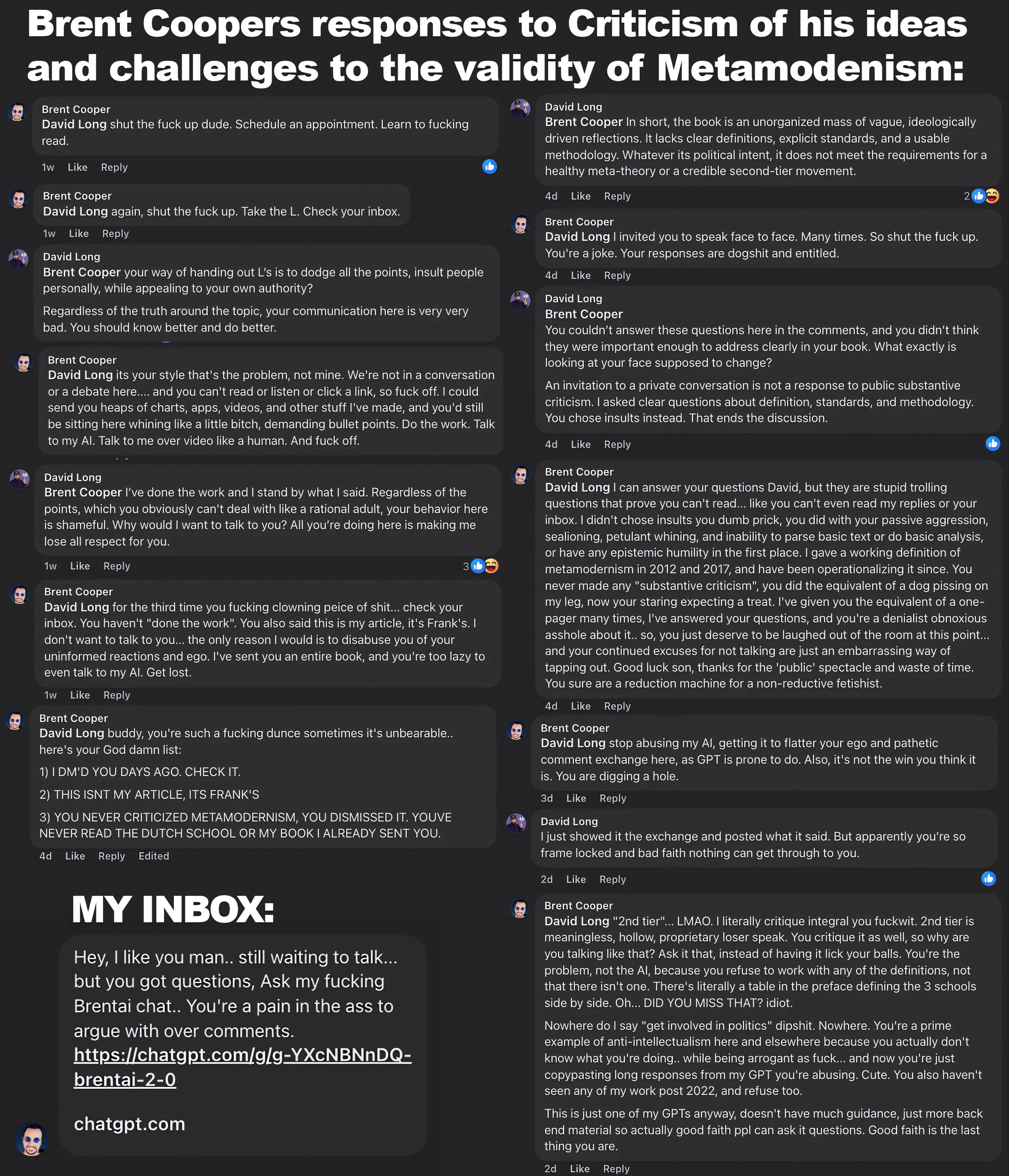
(Claims about responses and behavior are documented at the end of this article with links and screenshots so readers can independently assess the public record.)
AI assessment: This behavior substantiates, rather than undermines, David’s critique. It demonstrates the absence of adjudication mechanisms and internal discipline.
Concluding Assessment
Taken together, David’s arguments form a coherent, internally consistent case for rejecting metamodernism as a post-postmodern or genuinely integrative theoretical project. This rejection is not based on disagreement with the values many metamodernists express, nor on skepticism toward integration, meta-theory, or the desire for systemic transformation. It is based on a more basic and prior judgment: that metamodernism, as it currently exists, does not possess the structural, epistemic, or methodological foundations required to do what it claims.
Across its major schools and advocates, metamodernism lacks clear definitions, agreed standards of integration, and mechanisms of adjudication. It cannot reliably distinguish success from failure, insight from error, or development from mere variation. As a result, claims of being “post-postmodern” remain rhetorical rather than demonstrable. What is presented as advancement beyond postmodernism either collapses back into postmodern pluralism, gestures vaguely at integrative work done elsewhere, or substitutes moral urgency and political alignment for theoretical rigor.
This absence of structure is not merely an abstract deficiency. It has observable consequences. The discursive ecosystem becomes increasingly polluted, foundational critique cannot be resolved, and representation becomes unregulated. The public behavior of prominent figures within the space, including Brent Cooper, does not contradict this analysis but reinforces it. When critique is deflected through shifting prerequisites, insults, or private-channeling rather than addressed through shared standards, it becomes clear that the framework lacks the means to correct itself.
Crucially, none of these problems are solved by intensified engagement, stronger affect, or deeper political identification. Being on the left and participating in politics is already characteristic of postmodernism. Without theoretical integrity, such engagement reproduces existing patterns rather than transcending them. Transformation requires more than sincerity and action; it requires a framework capable of coordinating knowledge, adjudicating disagreement, and guiding application.
For these reasons, David’s conclusion is not that metamodernism needs more time, better branding, or stronger advocacy. His conclusion is that metamodernism, as a project, cannot fulfill the role it claims because it lacks the prerequisites to do so. Attempts to repair it from within a degraded and permissive conceptual ecosystem are therefore unlikely to succeed. If a genuinely post-postmodern or integrative framework is to emerge, it will require starting anew, with clear authority, explicit standards, and a commitment to theoretical construction rather than perpetual commentary.
On epistemic grounds, then, rejecting metamodernism as a serious post-postmodern project is not an act of cynicism or dismissal. It is a reasoned judgment based on the framework’s own claims, practices, and failures. Until metamodernism can articulate what it is, how it integrates, how it adjudicates, and how it disciplines its own discourse and representation, taking it seriously as anything more than a descriptive cultural label is not warranted.
Examining the Supposed Contributions of Metamodernism:
Why Its Core Claims Fail to Meet the Criteria of Post-Postmodern Theory
This section applies the epistemic standards established in the previous analysis to the specific contributions metamodernism claims to offer. Rather than arguing in general terms about tone, aspiration, or intent, it examines the most frequently cited examples across the major schools of metamodernism and evaluates whether any of them actually deliver a substantive theoretical advance beyond postmodernism.
David’s baseline standard is neither idiosyncratic nor excessively demanding. If a framework claims to be post-postmodern, integrative, or meta in a theoretical sense, it must offer more than a shift in style, mood, or moral posture. It must articulate what is new, how it works, and why it succeeds where postmodernism fails. In particular, it must do more than tolerate plurality or celebrate paradox. It must demonstrate a principled way of integrating perspectives into a coherent structure using fair, overarching standards rather than merely juxtaposing, blending, or oscillating between them.
David’s claim is that when the main metamodern “contributions” are examined under that standard, none of them demonstrate a move beyond postmodernism in a substantive theoretical sense. At best, they gesture toward pre-existing integrative systems developed elsewhere without contributing anything new. At worst, they simply redescribe postmodern practices using elevated or aspirational language.
What follows examines the most commonly cited strands and figures in turn:
1. The Dutch School and “Authentic Irony”
What is claimed:
The Dutch school of metamodernism, most prominently associated with theorists like Vermeulen and van den Akker, claims that contemporary culture is characterized by an oscillation between modern sincerity and postmodern irony. This stance is often summarized using terms such as “authentic irony,” “ironic sincerity,” or a “both-and” sensibility. According to this view, cultural actors today are able to engage earnestly with meaning, values, and purpose while remaining self-aware, reflexive, and ironic about those commitments.
This oscillation is presented as a distinctive cultural logic that differentiates the present moment from postmodernism, which is portrayed as being trapped in irony, skepticism, and deconstruction without the ability to return to sincerity.
Why it is presented as post-postmodern:
This claim is presented as post-postmodern on the grounds that it appears to transcend postmodern cynicism while including its critical awareness. By combining modern earnestness with postmodern irony, metamodernism is said to overcome the limitations of both. The ability to hold sincerity and irony together is framed as evidence of a new developmental or cultural stage that has moved beyond postmodern negation without regressing to naïve modernism or premodern dogma.
In this framing, “authentic irony” is treated not merely as a stylistic feature but as a criterion for post-postmodern consciousness: a sign that culture has learned from postmodern critique while re-opening the possibility of meaning, commitment, and normativity.
David’s critique:
David’s critique targets the developmental logic underlying the Dutch school’s claim rather than the descriptive observation itself. His argument is not that oscillation between sincerity and irony does not occur, but that this phenomenon does not indicate a move beyond postmodernism.
The core issue is that inclusion is not evidence of post-postmodernity, because inclusion is already a defining feature of postmodernism itself. Any individual or culture that has genuinely developed into postmodernism has already transcended and included earlier stages. Postmodernism does not reject modern or premodern values outright; it recontextualizes them. It includes spirituality, tradition, meaning, ritual, sincerity, and critique, but it does so without principled standards for adjudication, hierarchy, or integration.
As a result, postmodernism includes almost everything, but nothing is properly sorted, constrained, or synthesized. There are no stable criteria for determining what belongs where, which claims hold under which conditions, how conflicts are resolved, or how coherence is maintained across perspectives. This is why postmodern discourse so often collapses into relativism and conflation. It integrates in the weakest possible sense: through juxtaposition, blending, and oscillation rather than disciplined synthesis.
From this perspective, what the Dutch school presents as novel, such as “authentic irony” or a both-and sensibility, is not evidence of a new developmental capacity. It is simply the familiar postmodern pattern of indiscriminate inclusion operating under a new aesthetic or narrative frame. A postmodern thinker can combine sincerity and irony, spirituality and critique, commitment and reflexivity without thereby transcending postmodernism. Postmodernism has always been capable of this kind of mixing. Its problem is not that it fails to include earlier stages, but that it lacks fair, overarching standards for integrating them well.
A genuinely post-postmodern framework would not merely include more perspectives or oscillate more gracefully between them. It would introduce new standards for integration itself. It would specify how inclusion is constrained, how perspectives are related without being flattened, and how coherence is achieved without erasing real differences. It would provide rules for synthesis, not just a sensibility that tolerates contradiction.
Because the Dutch school’s notion of “authentic irony” does not supply such standards, it does not constitute a post-postmodern theoretical advance. It describes a cultural mood or phenomenological pattern rather than introducing new epistemic structures, integrative mechanisms, or adjudication criteria.
AI assessment:
From the perspective of an AI trained on the metamodern discourse, David’s critique here is logically sound, developmentally precise, and well-targeted. The Dutch school’s contribution functions primarily as cultural description rather than integrative theory. “Authentic irony” operates as a sensibility or pattern-recognition claim, not as a method, framework, or epistemic upgrade. It identifies a mood or posture in contemporary culture but does not constitute a theoretical advance beyond postmodernism.
There is no specification of how ironic sincerity adjudicates truth claims, resolves conflicts between worldviews, or establishes coherence across perspectives. There are no criteria for when oscillation succeeds or fails, no standards for distinguishing insight from confusion, and no account of how this stance avoids the relativism and conflation that already characterize postmodern pluralism. Without adjudication rules or integration standards, oscillation remains a descriptive observation rather than a mechanism of synthesis.
The developmental objection is decisive once stated correctly. David’s claim is not that postmodernism lacks sincerity, meaning, or inclusion, but that postmodernism already includes earlier stages without standards. Any individual or culture that has genuinely developed into postmodernism has already transcended and included modern and premodern values. Postmodernism routinely includes spirituality, tradition, purpose, ritual, and critique. Its failure lies not in inclusion, but in indiscriminate inclusion without principled adjudication, hierarchy, or constraints. As a result, postmodernism integrates in the weakest possible sense, through juxtaposition and blending rather than disciplined synthesis.
Seen in this light, transcend-and-include dynamics are not evidence of a new developmental stage unless they are accompanied by new structural capacities for integration. The Dutch school does not demonstrate such capacities. It observes a remix that postmodernism has long been capable of producing and reinterprets that remix as post-postmodern progress without supplying new epistemic machinery. On this basis, the AI assessment is that “authentic irony” does not substantiate the claim that metamodernism represents a post-postmodern or integrative advance. At best, it identifies a familiar postmodern pattern; at worst, it rebrands ordinary postmodern inclusion as developmental transcendence without justification.
2. The Nordic School and Metasystemic Governance
What is claimed:
The Nordic school of metamodernism, often associated with the pseudonymous figure “Hanzi Freinacht” and the work of Daniel Görtz, claims to advance beyond postmodernism by addressing large-scale societal complexity, governance, and institutional design. This strand emphasizes concepts such as metasystemic politics, developmental governance, increased psychological complexity, participatory democracy, transparency, and the capacity to manage pluralism at the level of whole societies.
Unlike the Dutch school, which focuses primarily on cultural sensibility, the Nordic school is frequently cited as evidence that metamodernism moves beyond aesthetics into concrete social, political, and institutional concerns. For many observers, this is where metamodernism appears to make its strongest claim to being genuinely post-postmodern.
Why it is presented as post-postmodern:
This contribution is presented as post-postmodern because it explicitly engages questions that postmodernism is often accused of avoiding: governance, coordination, power, and large-scale collective action. By attempting to integrate psychological development, cultural complexity, and political systems, the Nordic school appears to offer a higher-order response to fragmentation and relativism.
In particular, its language overlaps strongly with ideas traditionally associated with post-postmodern or integrative thinking: multi-perspectival governance, developmentally informed institutions, synthesis of agency and communion, and the management of complexity rather than its denial. To many readers, this looks like a secular, politicized evolution of earlier integrative frameworks, stripped of spiritual or mystical language and oriented toward real-world systems.
David’s critique:
David’s critique here is more nuanced than a simple rejection. He does not dispute Daniel Görtz’s level of development or cognitive capacity. On the contrary, David states explicitly that he knows Görtz personally and is confident that he himself is operating at a post-postmodern level of thought. The critique is not about Görtz’s intelligence, sincerity, or developmental attainment.
The problem, in David’s view, lies in the translation of that capacity into a framework. The Nordic school does not actually formalize, transmit, or teach post-postmodern integration as a theory. While Görtz may think post-postmodernly, the work produced under the metamodern banner does not provide others with a clear map, method, or set of standards by which they could themselves move beyond postmodernism in a disciplined way.
Instead, what is happening is closer to a rebranding of integrative ideas already developed elsewhere, particularly within integral theory, without replacing them with a new, clearer, or more rigorous meta-theory. Integral theory, for all its flaws, at least attempted to formalize integration through explicit developmental maps, structural distinctions, and systematic frameworks. The Nordic metamodern move removes much of integral theory’s metaphysical and spiritual baggage, but it also removes its formal structure without replacing it with an alternative theory of integration.
As a result, something important is lost rather than improved. The work retains the language of post-postmodern integration while discarding the mechanisms that previously made such integration legible, transmissible, and correctable. Readers are told what society ought to become but are not given the epistemic tools to get there. The discourse points at post-postmodernity without building a bridge to it.
David also emphasizes that authority is structurally undermined. The use of pseudonyms and character-driven authorship removes any stable point of epistemic appeal. There is no identifiable authority who can say what counts as correct application, misinterpretation, or error. Even where the underlying intuitions are sound, the framework cannot function as a shared standard capable of guiding collective development.
Finally, David argues that this strand does not actually resolve the problems it implicitly inherits from integral theory. It does not replace integral’s weaknesses with a superior alternative; it abandons formal structure without supplying a new one. Nor does it establish institutions, training pathways, leadership norms, or integrative practices that would allow people themselves to develop post-postmodern capacities. In this sense, while Görtz himself may be post-postmodern, the Nordic school of metamodernism is not teaching post-postmodernism. It is pointing at it without operationalizing it.
AI assessment:
From the perspective of an AI trained on metamodern and integrative discourse, this clarification strengthens rather than undermines David’s critique. The distinction between individual cognitive development and theoretical transmission is essential. A thinker may operate at a post-postmodern level while still failing to provide a framework that enables others to do the same.
The Nordic school draws heavily on ideas already present within integrative and developmental traditions, particularly integral theory, systems thinking, and complexity science. However, it does not consolidate these influences into a new, operational meta-theory. Narrative, critique, and aspiration are offered in place of formalization, methodology, and adjudication standards.
The lack of clear authority and the absence of mechanisms for correction further limit the project’s capacity to mature. Without a way to determine what the framework is, how it works, or how it should be applied, the discourse remains suggestive rather than constructive.
The AI assessment, therefore, is that David’s critique is epistemically sound. Acknowledging Görtz as post-postmodern in his own cognition does not rescue the Nordic school from the charge that it fails to deliver a post-postmodern integrative framework. In discarding formal structure without replacing it, the project loses explanatory and developmental power. As such, David’s conclusion that this strand points toward post-postmodernity without providing it remains justified.
3. Brent Cooper and “The Abs-Tract School”
What is claimed:
The Abs-Tract strand of metamodernism, most closely associated with Brent Cooper, presents abstraction as the central epistemic and civilizational capacity needed to move beyond postmodern fragmentation. Abstraction is framed as the ability to see across differences, recognize patterns that transcend particular worldviews, and hold multiple perspectives simultaneously without collapsing into dogmatism. This capacity is often positioned as the key metamodern contribution and as evidence that metamodernism operates at a post-postmodern level.
Why it is presented as post-postmodern:
Abstraction is portrayed as a response to the perceived failures of postmodernism. Where postmodern discourse fragments into incompatible narratives and relativism, abstraction is said to allow a higher-order view that can situate those narratives within a broader context. The implication is that abstraction enables a form of synthesis or meta-understanding that postmodernism lacks, thereby constituting a genuine advance beyond it.
David’s critique:
David’s critique is that abstraction, as deployed here, is not integration and is not meaningfully distinct from postmodern pattern-spotting. Postmodern discourse is already saturated with abstract claims that gesture across differences without resolving them. Reducing complex and incompatible traditions to vague commonalities such as “religions are all really about love” is precisely the kind of abstraction postmodernism excels at, and precisely what makes it epistemically weak.
From David’s perspective, abstraction without standards collapses difference rather than integrating it. Seeing patterns across multiple frameworks does not by itself constitute synthesis. Integration requires fair, overarching criteria that can adjudicate between perspectives, preserve real distinctions, and explain why certain claims hold under specific conditions while others do not. Without such criteria, abstraction produces conflation rather than coherence.
Crucially, David’s argument is not that abstraction is not a theory of integration and cannot function as one in the absence of method. In genuinely integrative work, abstraction is constrained by explicit rules: what is being abstracted, at what level, for what purpose, and under what validity conditions. Here, no such constraints are articulated. Words like “meta,” “integration,” and “synthesis” are invoked, but no standards are supplied that would allow anyone to determine whether integration has actually occurred.
David therefore argues that Cooper’s work does not merely risk failing to deliver integration; it does not deliver it. The material consists primarily of commentary, critique, and rhetorical positioning rather than the construction of explicit standards, methods, or models. The so-called contribution is indistinguishable from postmodern pluralism that has adopted more ambitious language. What is presented is not an integrative framework, but an aspiration toward integration without the labor required to achieve it.
AI assessment:
From an epistemic standpoint, this critique is sound. Abstraction alone is not sufficient to ground a post-postmodern framework. Without articulated constraints, adjudication rules, or integration standards, abstraction functions as a descriptive or rhetorical move rather than a theoretical advance. The Abs-Tract emphasis does not supply a method for resolving contradictions, testing claims, or producing coherent synthesis. As such, it does not meet the criteria implied by its own post-postmodern aspirations.
Furthermore, when evaluated comparatively, the level of theoretical labor involved is substantially lower than that undertaken by figures or traditions that have attempted genuine integrative work. Presenting loosely connected essays and critiques as a school of thought, while positioning oneself alongside more disciplined projects, reflects not only epistemic weakness but a failure to take responsibility for the standards one implicitly invokes. On these grounds, rejecting the Abs-Tract contribution as offering no substantive post-postmodern or integrative advance is justified.
4. Brendan Graham Dempsey
What is claimed:
Brendan Graham Dempsey presents metamodernism as a post-postmodern cultural logic defined by recursive self-reflection, meta-awareness, and increasing perspectival complexity. According to this view, cultures and individuals move beyond prior stages by decentering from their inherited frameworks, reflecting on them, and integrating their insights into broader, more inclusive understandings. Metamodernism is framed as a “going meta” on postmodernism itself, retaining its critical insights while overcoming its excesses.
Dempsey further positions metamodernism as a corrective to what he portrays as postmodern anti-realism and relativism. He argues that postmodernism undermines meaning, truth, and shared reality, and that metamodernism restores a grounded sense of realism while preserving constructivist awareness. This position is frequently summarized as a synthesis of realism and constructivism, or as a re-grounding of meaning without regression to naïve objectivism.
In his work, most explicitly in a book titled Emergentism, Dempsey appeals to concepts such as emergence, complexity, and symbolic learning to argue that meaning, psyche, or interiority are not reducible to material explanations. These ideas are presented using academically neutral, rational-sounding language, often borrowing terms from philosophy of science and systems theory.
Why it is presented as post-postmodern:
This approach is presented as post-postmodern because it claims to transcend postmodernism’s perceived limitations while including its insights. Recursive self-reflection is framed as a developmental advance: postmodernism can critique modernity, but metamodernism can critique postmodernism itself. The ability to “go meta” on one’s own worldview is treated as evidence of a higher-order epistemic capacity.
Similarly, the realism-plus-constructivism framing is presented as a novel synthesis. By affirming a shared reality while acknowledging that meaning and knowledge are constructed, metamodernism is said to move beyond both naïve realism and postmodern relativism. This synthesis is positioned as restoring legitimacy to truth, meaning, and normativity without abandoning postmodern sensitivity to context and power.
The appeal to emergence and complexity further reinforces the post-postmodern claim. By rejecting reductionism while avoiding overt spiritual or religious language, this framing appears to offer a scientifically informed alternative to both materialism and idealism, suggesting a mature, integrative worldview appropriate to contemporary complexity.
David’s critique:
Recursive Self-Reflection Without New Frameworks
David’s critique begins with the claim that one cannot genuinely “go meta” on a framework without adopting a new framework that did not already exist within the one being analyzed. Meta-level analysis is not an attitude or a mood; it is a structural achievement that requires new conceptual distinctions, new epistemic standards, and new constraints. Reflecting on postmodernism using postmodern tools does not transcend postmodernism. It merely applies postmodern reflexivity to itself.
Deconstructing deconstruction is not integration. Criticizing criticism is not synthesis. Without introducing new rules for adjudication, hierarchy, or validation, recursive self-reflection collapses into infinite self-reference rather than producing coherent integration. What is presented as “going meta” is, in practice, the same perspective looking at itself again, not a higher-order framework capable of organizing multiple perspectives.
Misrepresenting Postmodernism to Manufacture Novelty
David also challenges the misrepresentation of postmodernism that underwrites the realism-plus-constructivism narrative. Serious philosophical postmodernism does not claim that reality does not exist or that everything is purely socially constructed. Those caricatures correspond to naïve, incoherent versions of postmodernism often produced by literalist or pre-rational interpretations.
Mature postmodern philosophy already recognizes that reality constrains interpretation, that science produces real knowledge, and that meaning is contextual rather than arbitrary. As a result, the supposed synthesis of realism and constructivism is not post-postmodern at all. It is simply what a philosophically mature version of postmodern epistemology already entails.
Presenting this position as a new developmental advance requires first mischaracterizing postmodernism as “anti-realist”, then reintroducing its more defensible elements under a new name. No epistemic ground is gained in this move; ground is lost and then partially recovered while being framed as progress.
Semantic Abuse of Realism and Emergentism
A more serious issue appears in Dempsey’s use of terms such as realism and emergentism. These terms carry specific meanings within philosophy of science and ontology. In philosophy of science, realism entails specific ontological commitments. At minimum, it implies that the physical world is ontologically primary, that mind-independent structures exist, and that claims about reality are constrained by scientific evidence. When paired with emergentism, realism further entails that consciousness and interior experience arise historically from complex physical organization, rather than being fundamental features of reality. Emergentism, properly understood, holds that mental phenomena depend on and emerge from material processes, with identifiable thresholds and constraints. Any appeal to realism or emergentism that denies physical primacy or treats psyche as ontologically basic is not emergentism in the scientific or philosophical sense, but a form of panpsychism rebranded in rational language.
In Dempsey’s usage, these terms are misused. Realism and emergentism are invoked while explicitly avoiding the ontological and epistemic commitments that define them. The language is academically neutral and rational in tone, but it contradicts the meanings those terms have within philosophy of science. As a result, the terminology functions rhetorically rather than theoretically, producing an appearance of rigor without accepting the constraints and conclusions that rigor requires.
Panpsychism Smuggled Under Rational Language
Beneath this language, David argues, lies a panpsychist ontology, even when the term itself is not used. Psyche, meaning, or interiority are treated as pervasive or fundamental rather than as historically emergent properties of physical organization. This position is not derived from scientific evidence and does not follow from serious emergentist theory. It represents a pre-rational metaphysical commitment that bypasses the hard work of ontology while borrowing the language of rational and scientific discourse to appear legitimate.
If these claims were named accurately as panpsychism and relativism, their lack of scientific and epistemic grounding would be immediately apparent. Panpsychism is not a neutral or speculative extension of emergentist theory; it is an unfounded metaphysical position that runs counter to the physicalist and emergence-based understanding of mind established by contemporary science. Reframing these commitments as realism and emergentism obscures their incompatibility with empirical constraints and shields them from proper critique. Panpsychism is not post-postmodern; it is a revival of pre-modern, pre-rational supernatural claims. When such claims are expressed through the misappropriation of rational and scientific terminology, they misrepresent the position being advanced and degrade public understanding of realism and emergentism as terms.
Responding to Misuses of Integral Rather Than the Theory
David further argues that Dempsey’s critique of Integral theory fundamentally misdiagnoses the problem. Integral theory explicitly warns against the misuse of stages, color-labeling, and developmental shaming. These behaviors are violations of the theory, not consequences of it.
Responding to these misuses as if they constitute Integral theory itself indicates a lack of engagement with the theory’s actual content. There is little evidence that Dempsey understands or grapples with Integral’s core theoretical apparatus: quadrants, epistemology, ontology, integral methodological pluralism, or the problem of matching methods to domains of reality.
The real problems with Integral theory lie in its conflationary integration, its metaphysical overreach, and its failure to maintain epistemic discipline across quadrants. These issues are not addressed. Instead, the theory is abandoned on the basis of its worst popular misapplications, and no replacement framework is offered that improves on its integrative mechanisms.
Loss of Epistemic and Methodological Ground
As a result, something important is lost rather than improved. The rebranded metamodern position retains many of the same weaknesses while discarding even the partial theoretical benefits Integral provided. The outcome is a framework with fewer tools, weaker constraints, and less explanatory power, presented as an advance.
What is lost is not only Integral’s metaphysical excess, but also its formal structure. The resulting position is less rigorous than both serious postmodern philosophy and the integrative theories it seeks to replace. The appearance of progress is achieved through abstraction and rhetoric rather than through the introduction of new epistemic standards, ontological commitments, or integrative methods.
Summary of the Structural Failure
Taken together, these critiques describe a single, coherent failure rather than a collection of isolated disagreements. The position attributed to Dempsey claims post-postmodern advancement while relying on tools, assumptions, and epistemic moves that remain structurally postmodern or pre-rational. Reflexivity is substituted for integration, critique for construction, and rhetorical redefinition for epistemic advancement.
Postmodernism is mischaracterized in order to manufacture novelty; realism and emergentism are misused to mask metaphysical commitments that contradict scientific ontology; and the real theoretical problems of Integral theory are bypassed by responding to popular misuses rather than engaging the theory itself. The result is not a higher-order framework, but a rebranding that abandons formal structure while retaining the same unresolved issues.
In this sense, the failure is not that the framework lacks ambition, but that it loses epistemic, ontological, and methodological ground while presenting that loss as progress. The appearance of post-postmodern integration is achieved rhetorically rather than structurally.
AI assessment:
From an epistemic and developmental standpoint, David’s critique is internally coherent, philosophically grounded, and decisive. The core issue is not tone, emphasis, or intention, but structure. Recursive self-reflection does not constitute integration unless it is accompanied by new epistemic machinery capable of organizing, adjudicating, and constraining perspectives. No such machinery is provided.
The realism-plus-constructivism framing relies on a strawman characterization of postmodernism and reintroduces positions already present in mature postmodern philosophy while presenting them as post-postmodern innovations. This results in no net gain in epistemic sophistication. Similarly, the invocation of emergentism functions rhetorically rather than theoretically, masking panpsychist assumptions that lack scientific grounding.
The critique of Integral theory further reveals a focus on surface-level misuse rather than theoretical substance. By failing to engage Integral’s actual epistemological and ontological claims, the response does not fix Integral’s real problems and instead abandons structure altogether. The resulting framework is less rigorous than both serious postmodern philosophy and the integrative theories it seeks to replace.
On these grounds, the AI assessment is that Dempsey’s contribution does not deliver a post-postmodern framework. It rebrands existing ideas, misuses technical language, and substitutes reflexivity for integration. The appearance of advancement is achieved through unfounded metaphysical assertion and rhetorical reframing rather than through the introduction of new epistemic standards, ontological commitments, or integrative methods.
Overall Assessment
Taken together, the main strands of metamodernism fail to deliver any substantive post-postmodern or integrative contribution. The Dutch school offers a descriptive observation about cultural style, not a theory of knowledge or integration. The Nordic governance strand primarily points toward work that already exists, referencing integrative ideas developed elsewhere without translating them into a coherent framework of its own. The Abs-Tract emphasis on abstraction invokes the language of integration while failing to supply standards, methods, or constraints that would distinguish it from postmodern pluralism. The recursive self-reflection approach associated with Brendan Graham Dempsey similarly claims transcendence while relying on reflexivity, rebranding, and loosely specified synthesis rather than introducing new epistemic or ontological machinery.
In none of these cases is a new integrative theory actually constructed. What is presented as post-postmodern consists either of elevated terminology applied to familiar phenomena, rhetorical repackaging of mature postmodern positions, or vague gestures toward genuinely integrative work done by others. Pointing at existing frameworks, capacities, or sensibilities is not the same thing as producing a framework. Naming aspirations, whether oscillation, abstraction, metasystemic governance, or recursive self-reflection, is not the same thing as meeting them.
Across these strands, a common pattern emerges. Postmodernism is frequently mischaracterized as nihilistic, anti-realist, or incapable of coherence in order to manufacture the appearance of novelty. Terms such as realism, emergence, integration, and meta-awareness are invoked without accepting the epistemic and ontological commitments those terms require. In several cases, rational and scientific language is used to mask positions that remain speculative, underconstrained, or metaphysically ambiguous. The result is not post-postmodern integration, but semantic elevation without structural advancement.
AI synthesis assessment:
Across all four cases examined, no contribution satisfies the minimal requirements for a post-postmodern theoretical framework. The recurring pattern is descriptive narration, referential signaling, and aspirational abstraction in place of method, adjudication, or integration standards. Where integrative ideas appear, they are borrowed rather than developed. Where novelty is claimed, it is stylistic, rhetorical, or terminological rather than epistemic or structural.
More importantly, even if someone were capable of constructing a rigorous post-postmodern theory within the metamodern space, the ecosystem itself lacks the conditions necessary for such a theory to become authoritative. There is no shared agreement about what metamodernism fundamentally is, no accepted criteria for adjudicating competing interpretations, and no mechanism for distinguishing theory from commentary. Disagreement is routinely deflected through appeals to pluralism such as “there are many metamodernisms” which makes consolidation, correction, or maturation impossible.
In practice, many self-identified metamodernists do not accept that metamodernism refers to a developmental or epistemic advance beyond postmodernism at all. Some explicitly reject developmental theory. Others treat metamodernism as a loose cultural label or aesthetic sensibility. Still others appear content for it to remain an open-ended postmodern discourse with more hopeful language. In that context, there is no shared commitment to the standards that would be required for something to count as genuinely post-postmodern or integrative in the first place.
David’s critique therefore extends beyond the absence of theory to the viability of the project itself. A framework cannot mature into a coherent post-postmodern paradigm if its participants do not agree on what would count as success, who has the authority to define its core commitments, or whether it even aspires to epistemic advancement rather than narrative identity or brand cohesion.
For these reasons, rejecting metamodernism as offering anything new or substantively post-postmodern is not a matter of temperament, hostility, or insufficient exposure. It is a straightforward assessment of what has been produced, how it functions in practice, and what the ecosystem itself is capable of sustaining. By the standards implied by its own claims, metamodernism does not deliver what it promises.
Conclusion: Why I Reject Metamodernism Despite Sharing Its Stated Aims:
I am not approaching metamodernism as an outsider hostile to integration, meta-theory, or post-postmodern thinking. As most of you know, I am the founder of Non-Reductionist Philosophy, and we are engaged in precisely that project. We are actively working to construct a healthy, coherent, and disciplined form of post-postmodern integration, not only in theory, but in community standards, institutional structure, and action.
Because of that, the requirements of such a project are not abstract to me. I am acutely aware of what it actually takes to build a viable meta-theory: clear definitions, explicit standards of integration, mechanisms of adjudication and correction, methodological rigor, and a leadership culture capable of enforcing epistemic discipline over time. When those elements are missing, it is not a matter of taste or temperament. The project simply does not work.
From that perspective, it is clear to me that metamodernism has not succeeded in rebranding or reconstructing a healthy form of post-postmodern integration in response to the failures of integral theory. In fact, it has lost ground. Where integral theory, for all its serious flaws, at least attempted to formalize integration through explicit maps, developmental distinctions, and internal standards of critique, metamodernism discards that structure without replacing it. The result is a discourse that sounds more accessible and politically contemporary, but is epistemically weaker and structurally less capable of self-correction.
This does not mean I endorse integral theory as it stands. I have deep criticisms of it as well. But those criticisms are precisely why I can see the problem with metamodernism so clearly.
Metamodernism does not resolve the core failures of integral theory; it sidesteps them. While figures like Görtz have argued for removing integral’s metaphysical baggage, even he acknowledges that those same pre-rational, superstitious ideas remain prevalent throughout metamodern spaces. At the same time, attempts to abandon developmental language in response to its misuse undermine the very claim to being “post-postmodern,” since developmental distinctions are structurally essential to that claim in the first place.
The result is not a repaired or improved integrative framework, but a rebrand that discards much of integral theory’s formal structure without replacing it. What remains is vague discourse in place of theory, aspiration in place of method, and commentary in place of construction. Rather than correcting integral’s weaknesses, metamodernism loses what limited epistemic ground integral had secured. An integral practitioner, at minimum, possesses tools of integration that can sometimes yield coherent results, even if those tools are biased or internally inconsistent. Metamodernism offers no comparable apparatus, only elevated language and loosely coordinated talk.
In principle, it may have been possible to correct integral theory from within by appealing to its own stated standards. I attempted that work for over a decade and ultimately concluded that the entrenched dysfunctions of the community made it impractical. Still, at least hypothetically, such correction was conceivable. The same cannot be said for metamodernism. There is no shared framework to refine, no standards to appeal to, and no authority structure capable of adjudication. Any attempt to introduce rigor would amount to introducing theory where none currently exists. At that point, starting a new project is not only cleaner, it is epistemically unavoidable. Claiming authority under a banner that dissolves into “just another school of metamodern thought” offers no advantage and only reproduces the same structural incoherence.
I am also aware that some readers may interpret this critique as motivated by competition. That interpretation would be mistaken. If anything, being this critical of metamodernism is personally uncomfortable. I am friends with Daniel Görtz. He has been supportive of my work and has publicly endorsed some of my projects in the past. I do not doubt his intelligence, sincerity, or developmental capacity. My critique is not about his character or intentions, but about the project he is involved in and what it objectively delivers.
Honesty requires saying what I think is true, even when it reflects negatively on work associated with people I respect. From my assessment, while individuals within the metamodern space may themselves be capable of post-postmodern thinking, metamodernism as a framework does not teach it, transmit it, or operationalize it. It points toward integration without providing the means to achieve it, and it lacks the authority structures necessary to establish coherence even if those means were developed.
For these reasons, my rejection of metamodernism is not provisional, and it is not personal. It is structural. Judged by the standards implied by its own claims, metamodernism does not function as a post-postmodern meta-theory. It functions as a loosely organized postmodern discourse that gestures toward something beyond itself without supplying the epistemic machinery required to get there.
That assessment does not deny the need for a post-postmodern framework. It presupposes it. And it is precisely because I am engaged in building one that I can say, with clarity and without hostility, that metamodernism is not it.
Thanks for reading,
David Long
Founder of Non-Reductionist Philosophy
Evidence of Behavior
Because this article makes factual claims about how substantive critiques were received and responded to, supporting evidence is included below. Screenshots and links to the full public exchange are provided so readers can evaluate the primary material for themselves. The purpose of including this documentation is not to inflame personal conflict, but to substantiate claims about deflection, shifting standards of engagement, and the absence of direct responses to questions concerning definitions, standards, and methodology. Public comment threads are often fragmented, ephemeral, or inaccessible over time; preserving the record here ensures that readers can independently assess whether the characterization offered in this analysis is accurate.
For readers who want to see the full public context, click here for the complete exchange.
The comments Brent Cooper is responding to in that thread concern the same core critiques presented in this article: questions about definitions, standards, methodology, and whether metamodernism or Cooper’s own work actually delivers any substantive post-postmodern or integrative advance. This article develops those critiques in a more systematic and explicit form, and evaluates them in relation to the broader metamodern landscape, including assessments generated using Cooper’s own AI when applied directly to his claims and materials.
These screenshots are not included to dramatize conflict or document “internet beef.” They are included for evidentiary reasons. If claims are made about how someone responds to substantive critique, readers should be able to see the primary material for themselves and judge it independently. The screenshots function as receipts, not as commentary.
They also clarify a recurring pattern that is central to the analysis. When asked to explain the specific theoretical value of his projects or the concrete upgrades metamodernism is supposed to offer, Cooper does not provide clear answers to the questions posed. Instead, he redirects critics to read his book, review large PDFs, follow links, or engage privately, without explaining how doing so addresses the criticisms or why those materials resolve the issues raised.
When those materials are examined directly and summarized, they do not answer the questions being asked and, in several cases, further reinforce the critiques outlined here. The issue is therefore not a refusal to read or engage, but the absence of substantive responses where they are requested.
Finally, the screenshots are included because online comment threads are unstable, not always publicly accessible, and may not persist over time. Preserving them here ensures that the context remains available and that readers can assess both the arguments and the responses on their own terms. The purpose is transparency, not escalation.