

Quadrants:
A More Complete Framework for Holistic Thinking
Reality is complex. Every important question involves multiple aspects that interact with one another, yet people naturally tend to focus on only the parts they are most familiar with. Scientists often reduce problems to measurable physical processes. Psychologists may focus primarily on subjective experience. Historians emphasize culture, while economists emphasize systems and incentives. Each perspective captures something real, but none of them tells the whole story.
This tendency to mistake part of reality for the whole is known as reductionism, and it is one of the most common sources of confusion in philosophy, science, politics, psychology, and everyday life. Many disagreements are not caused by one side being completely wrong, but by different people emphasizing different aspects of reality while overlooking the rest.
Holistic thinking is the practice of taking all of the relevant aspects of reality into account before arriving at a conclusion. Rather than asking which perspective is correct, a holistic approach asks what each perspective contributes, where its limits are, and how it fits together with everything else. The goal is not simply to accumulate more information, but to organize it into a coherent understanding of reality.
The Quadrants are one of the most powerful tools for doing exactly that. They provide a simple but rigorous framework for identifying the four major ontological zones that together make up a complete picture of reality. More importantly, they help us avoid common forms of reductionism by reminding us that no single aspect of reality can adequately explain every phenomenon.
In this article, we will explore the Non-Reductionist presentation of the Quadrants and several important advances that make them significantly more powerful as a framework for holistic thinking. We will begin with the more fundamental thinking tool known as Divisions of Four, then introduce the Quadrants themselves before exploring three major contributions: Quadratic Zoom and Scale, the NRP Macro-Micro Map, and Primacy with Nested Quadratic Holons. Together, these ideas transform the Quadrants from a simple checklist into a comprehensive methodology for understanding reality across multiple levels of organization.

Divisions of Four
A Division of Four is created by crossing two related distinctions, producing four meaningful combinations. Although the idea is simple, it is one of the most versatile thinking tools ever developed. Throughout history, Divisions of Four have been used to organize information, generate perspectives, compare possibilities, classify relationships, and reveal patterns that are difficult to see through simpler forms of analysis.
One of their greatest strengths is that they help us move beyond simplistic either-or thinking. Rather than reducing complex questions to a single binary distinction, Divisions of Four allow us to explore how two important distinctions interact with one another. This often reveals perspectives, relationships, and possibilities that would otherwise remain hidden.
In the accompanying video, I explore a wide range of examples drawn from psychology, philosophy, negotiation, religion, types, politics and everyday life to demonstrate just how broadly this tool can be applied.
Quadrants become much easier to understand once they are recognized as a specific application of this more general thinking tool. Rather than appearing as an isolated framework to memorize, they can be understood as one particularly important use of Divisions of Four. Learning the broader tool first not only provides useful analytical skills in its own right, but also gives the Quadrants a clearer conceptual foundation.
For readers who are new to this idea, I strongly recommend watching the accompanying video. The visual demonstrations are the best way to develop an intuitive understanding of how Divisions of Four work and why they are such a powerful tool for holistic thinking.
The big 3
Before introducing the Quadrants, it is helpful to begin with an older and simpler framework that has influenced philosophy for over two thousand years.
Plato famously spoke of the Good, the True, and the Beautiful as three fundamental ideals that together capture essential dimensions of reality and human flourishing.
Aristotle approached many of these same domains through his work on ethics, natural philosophy, and poetics, distinctions that today we might more naturally describe as morals, science, and art.
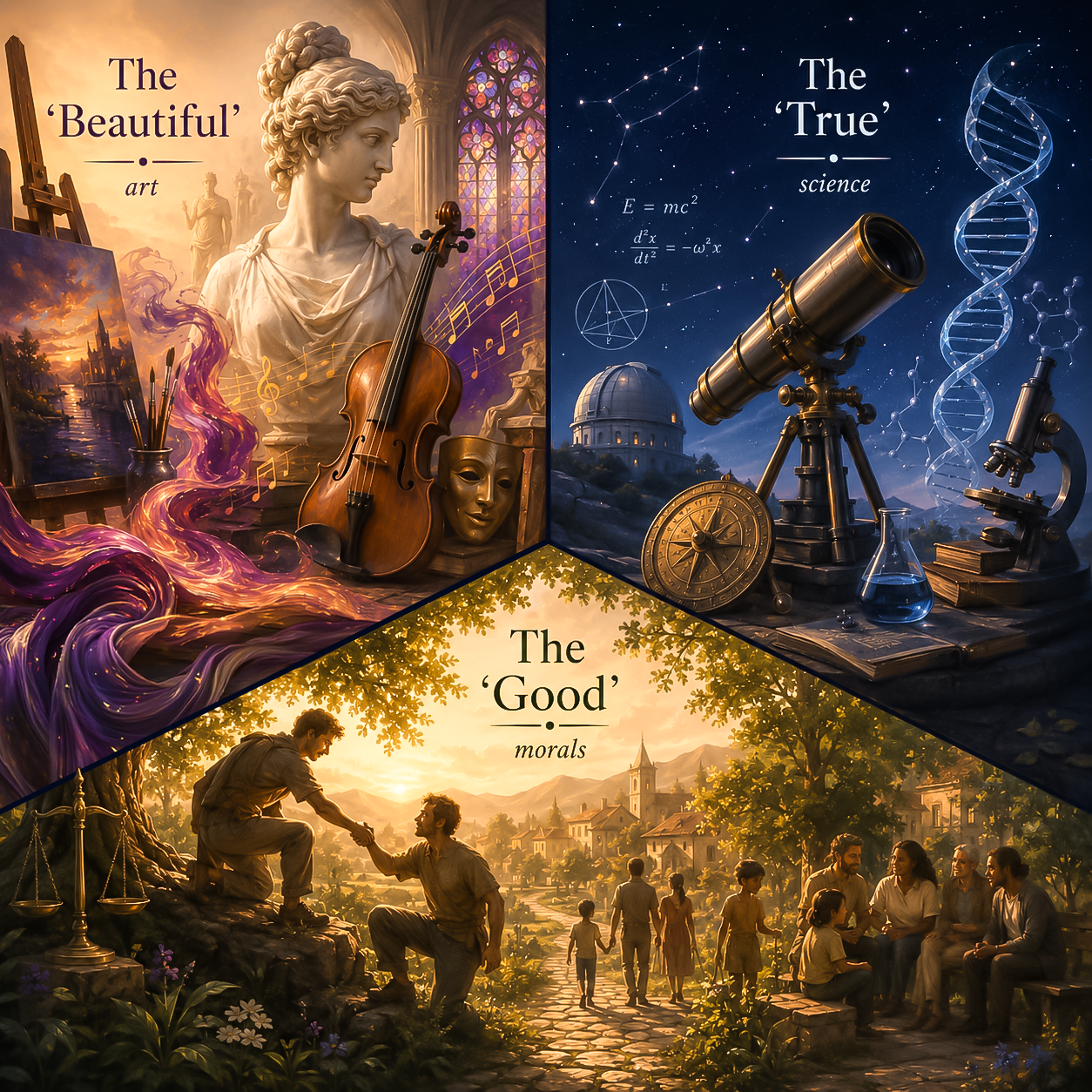
Although these philosophers developed their ideas in different ways, they shared the insight that reality cannot be adequately understood from a single point of view. Human life involves multiple fundamental domains, each requiring its own way of understanding and evaluation.
The Quadrants preserve this classical insight while expanding it into a more complete ontological framework. Rather than stopping at three broad domains, they distinguish four irreducible ontological zones by separating not only interiors from exteriors, but also individuals from collectives. This additional distinction provides a more comprehensive foundation for holistic thinking while remaining deeply connected to a philosophical tradition that stretches back to the beginnings of Western philosophy.
Now that we understand Divisions of Four as a general thinking tool, we can explore one of their most important applications: the Quadrants.
While Divisions of Four can be used to generate perspectives, compare possibilities, and organize information about almost anything, the Quadrants do something much more specific. They apply this structure to ontology, the branch of philosophy concerned with the fundamental aspects of reality. Rather than simply organizing ideas, the Quadrants provide a map of the major ontological zones that together make up a holistic picture of the world.
Quadrants
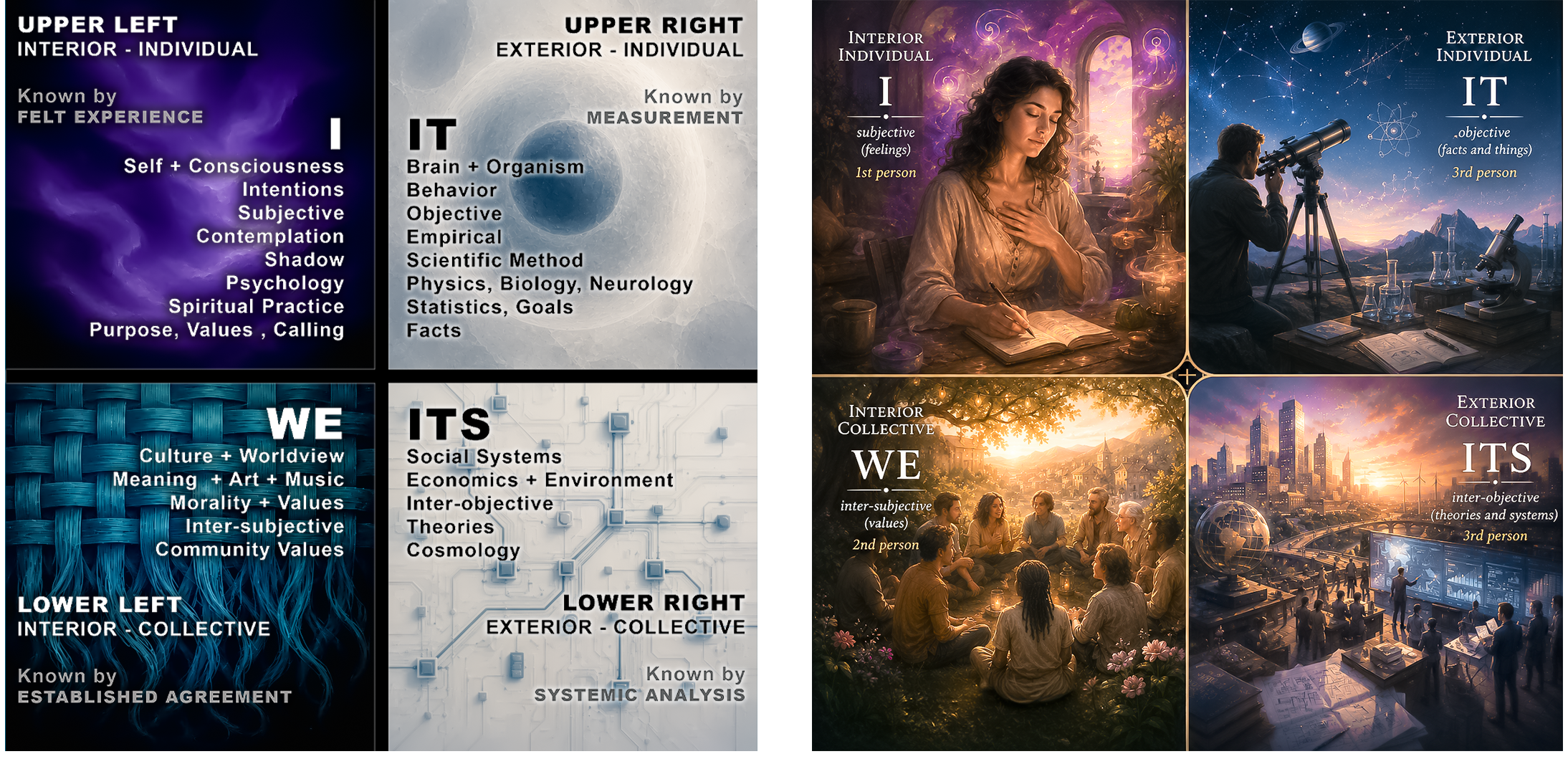
The Quadrants distinguish four irreducible ontological zones. Each quadrant represents a distinct aspect of reality that cannot be reduced to any of the others. Together, they provide a simple but comprehensive framework for holistic thinking.
Upper Left (I) Interior • Individual • First-Person • Subjective
The Upper Left represents the individual's inner world. It is the domain of consciousness, subjective experience, thoughts, emotions, intentions, values, meaning, identity, purpose, imagination, psychology, and everything that can only be directly known through first-person experience. This is the subjective domain of reality and is primarily understood through introspection, phenomenology, and lived experience.
Upper Right (It) Exterior • Individual • Third-Person • Objective
The Upper Right represents observable individual things. It includes the brain, body, behavior, and everything that can be investigated empirically. This is the objective domain of reality and is primarily understood through measurement, experimentation, and the scientific method.
Lower Left (We) Interior • Collective • Second-Person • Inter-Subjective/Relative
The Lower Left represents the shared interior world of groups. It includes language, culture, morality, relationships, traditions, values, and shared meaning. These realities emerge between people and are sustained through communication, participation, and established shared agreement.
Lower Right (Its) Exterior • Collective • Third-Person • Inter-Objective
The Lower Right represents collective exterior systems. It includes institutions, governments, economies, technologies, ecosystems, infrastructure, organizations, networks, and the complex relationships that exist between objective entities. It is also the home of systems thinking and theoretical models that explain how these structures function.
Together, these four ontological zones provide one of the most useful frameworks for holistic thinking. They remind us that reality cannot be adequately understood through subjective experience, objective science, culture, or systems alone. Each quadrant captures a genuinely different aspect of reality that contributes to a more complete understanding of the whole.
Every phenomenon can be understood in relation to these distinctions, making the Quadrants a remarkably general framework for holistic analysis. The categories within each quadrant may change depending on the subject, but the ontological structure remains the same.
The Absolute
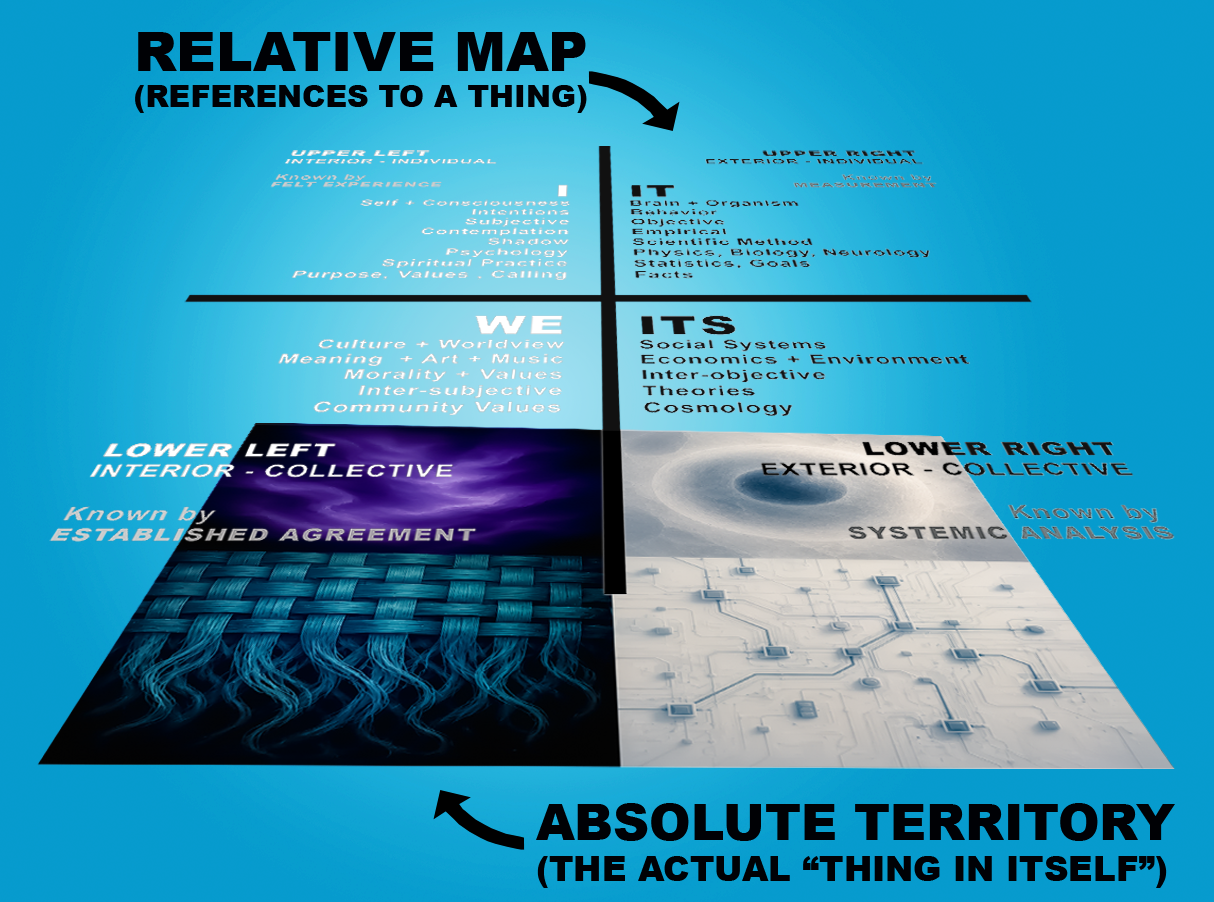
It is also important to distinguish the map from the territory.
The Quadrants are not reality itself. They are a conceptual map used to understand reality.
In the Non-Reductionist presentation, the Quadrants are shown resting above the Absolute rather than surrounding it. The Absolute represents reality itself, while the Quadrants represent the distinctions we make within reality in order to better understand it. The Absolute is not a fifth quadrant or another ontological zone. It is the territory that our philosophical map attempts to describe.
Keeping this distinction clear reminds us that every philosophical framework is ultimately a model of reality rather than reality itself. The purpose of philosophy is not to mistake the map for the territory, but to continually refine our maps so they more accurately reflect the world they seek to explain.
Because the Quadrants describe aspects of reality rather than specific subjects, they can be applied to virtually any domain. Whether we are studying a person, a scientific theory, an organization, a historical event, a work of art, or an entire civilization, the same four ontological zones remain relevant. What changes is not the framework itself, but the specific content being mapped.
Even in their simplest application, the Quadrants are an extraordinarily useful thinking tool.
One of the first things many people discover when they begin using the Quadrants is that they naturally favor certain quadrants while neglecting others. Some people are primarily drawn to objective facts and measurable evidence. Others focus more on personal experience, relationships, or systems thinking. Becoming aware of these tendencies is valuable because it helps us recognize our own blind spots. As we intentionally develop the quadrants we tend to overlook, we become more balanced thinkers and more well-rounded people.
The Quadrants as a Holistic Checklist
The Quadrants are also an incredibly useful checklist for everyday life. Imagine you're preparing to move to a new city. Most people naturally think about the objective tasks involved in the move: making a to-do list, packing boxes, organizing transportation, and taking care of all the practical details. These are all important Upper Right concerns.
The Quadrants remind us that there are other aspects of reality worth considering as well. In the Upper Left, we might ask ourselves how we actually feel about the move. Are we excited? Anxious? Sad to leave? Taking time to understand our own experience can help us make wiser decisions and navigate the transition more intentionally.

In the Lower Left, we can think about our relationships and community. How will this move affect the people in our lives? Should we spend meaningful time with friends before leaving? What kinds of relationships and communities do we hope to build after we arrive? These shared and cultural dimensions are easy to overlook if we're only focused on logistics.
Finally, the Lower Right encourages us to step back and consider the bigger picture. How does this move fit into our overall life plan? What systems, opportunities, and long-term structures are we moving toward? How does this decision support the direction we ultimately want our life to take?
Thinking through each of these ontological zones provides a much more holistic understanding of the project. Instead of focusing only on the practical tasks, the Quadrants help us remember the personal, relational, and systemic dimensions that also deserve our attention. This simple habit dramatically reduces blind spots and helps prevent many of the most common forms of reductionism.
However, this is only the beginning.
Treating the Quadrants as a holistic checklist is already incredibly valuable, but it barely scratches the surface of what they are capable of doing. In the following sections, we'll explore several contributions unique to Non-Reductionist Philosophy that expand the Quadrants into a far more rigorous methodology. By introducing Quadratic Zoom, Scale, the NRP Macro-Micro Map, Primacy, and Nested Quadratic Holons, the Quadrants become much more than a reminder to "consider all four." They become a comprehensive framework for organizing knowledge, avoiding reductionism, and understanding how the different aspects of reality relate to one another across multiple levels of analysis.
Quadratic Zoom & Scale
One of the biggest limitations of using the Quadrants as a simple checklist is that they tell us what aspects of reality to include, but they do not tell us at what level of organization we should be examining them.
This is the problem that Quadratic Zoom and Scale are designed to solve.
Quadratic Zoom is the ability to move between different levels of organization while maintaining a complete view of all four ontological zones. Rather than treating the Quadrants as a single static diagram, Quadratic Zoom recognizes that the same four ontological zones exist at many different levels of reality. We can zoom out to examine broad patterns, zoom in to examine finer details, or move back and forth between levels of scale while remaining grounded in the same ontological framework.
This raises a more rigorous question than simply asking:
"Did I remember all four quadrants?"
Instead, we begin by asking:
"What is the appropriate level of scale for understanding this particular problem?"
Once we have identified the appropriate level of analysis, we can then ask whether we have adequately considered all four ontological zones at that level. At whatever level of analysis we start we call that the intermediate scale and them track higher and lower levels of zoom from there.
This seemingly simple shift has profound implications.
Many apparent applications of holistic thinking are not actually holistic at all. A person may believe they have considered all four quadrants while unknowingly mixing together information from completely different levels of organization. As a result, they end up comparing things that do not belong together, overlooking important distinctions, or assuming that because one quadrant has been represented somewhere, it has been adequately addressed everywhere.
Quadratic Zoom helps prevent this kind of zoom-level conflation and quadratic reductionism.
Rather than treating reality as though it existed on only one level of analysis, it recognizes that every phenomenon exists within larger wholes while also containing smaller parts. Understanding something well often requires moving between these levels, seeing how each contextualizes the others, and identifying the level at which the question should primarily be answered.
For example, when studying a person, we might zoom out to examine their role within a family, community, or society. We might then zoom in to examine their psychology, physiology, or even cellular biology. Each level reveals different information, but none of these perspectives replaces the others. Instead, each level helps contextualize the rest.
One of the reasons this is possible is that Non-Reductionism understands the Quadrants as ontological zones rather than merely different perspectives. Because the Quadrants describe fundamental aspects of reality itself, their basic structure remains stable as we move between different levels of organization. The content changes, but the ontological framework does not. This provides a solid framework that allows us to navigate reality without constantly redefining the categories we are using.
The practical implications extend far beyond philosophy.
Quadratic Zoom provides a general methodology for deciding where to investigate a problem before deciding how to investigate it. It encourages us to identify the appropriate level of organization, understand that level in the context of the larger systems that contain it, and then zoom in further whenever a deeper level of analysis is needed.
Rather than asking only whether we have considered the four ontological zones, Quadratic Zoom asks whether we are examining the right level of reality, whether we understand how that level relates to the levels above and below it. This transforms the Quadrants from a simple reminder into a much more rigorous analytical methodology. They no longer function merely as a checklist for avoiding reductionism. They become a framework for understanding reality across multiple levels of organization while avoiding one of the most common forms of philosophical confusion: mistaking one level of scale for another.
This provides the conceptual foundation for later Non-Reductionist methodologies, including the NRP Macro-Micro Map, Primacy, Nested Quadratic Holons, and 4P4Z. Each of these builds upon the basic insight that reality can be examined at multiple levels of organization without abandoning the same underlying ontological framework.
The NRP Macro-Micro Map
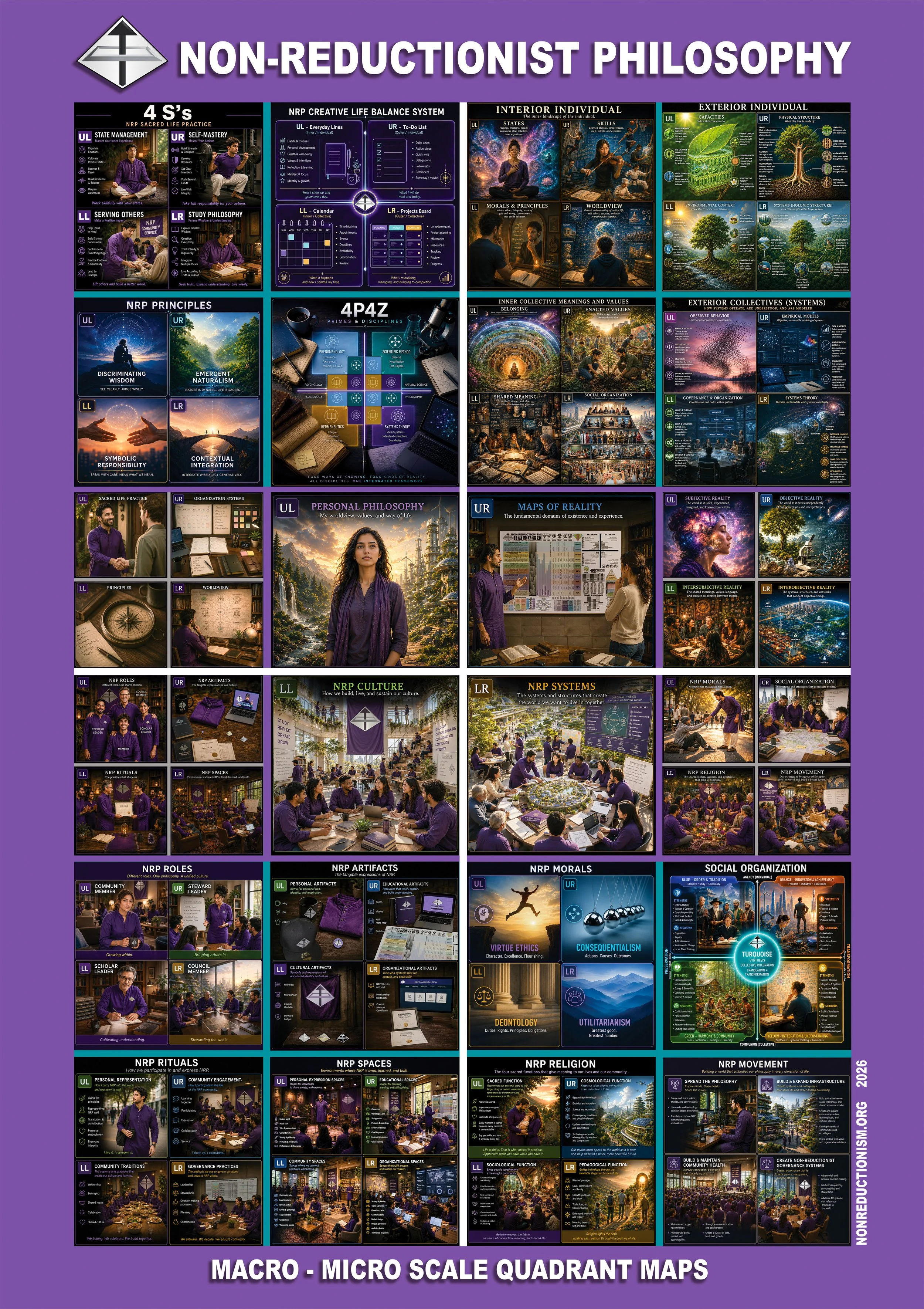
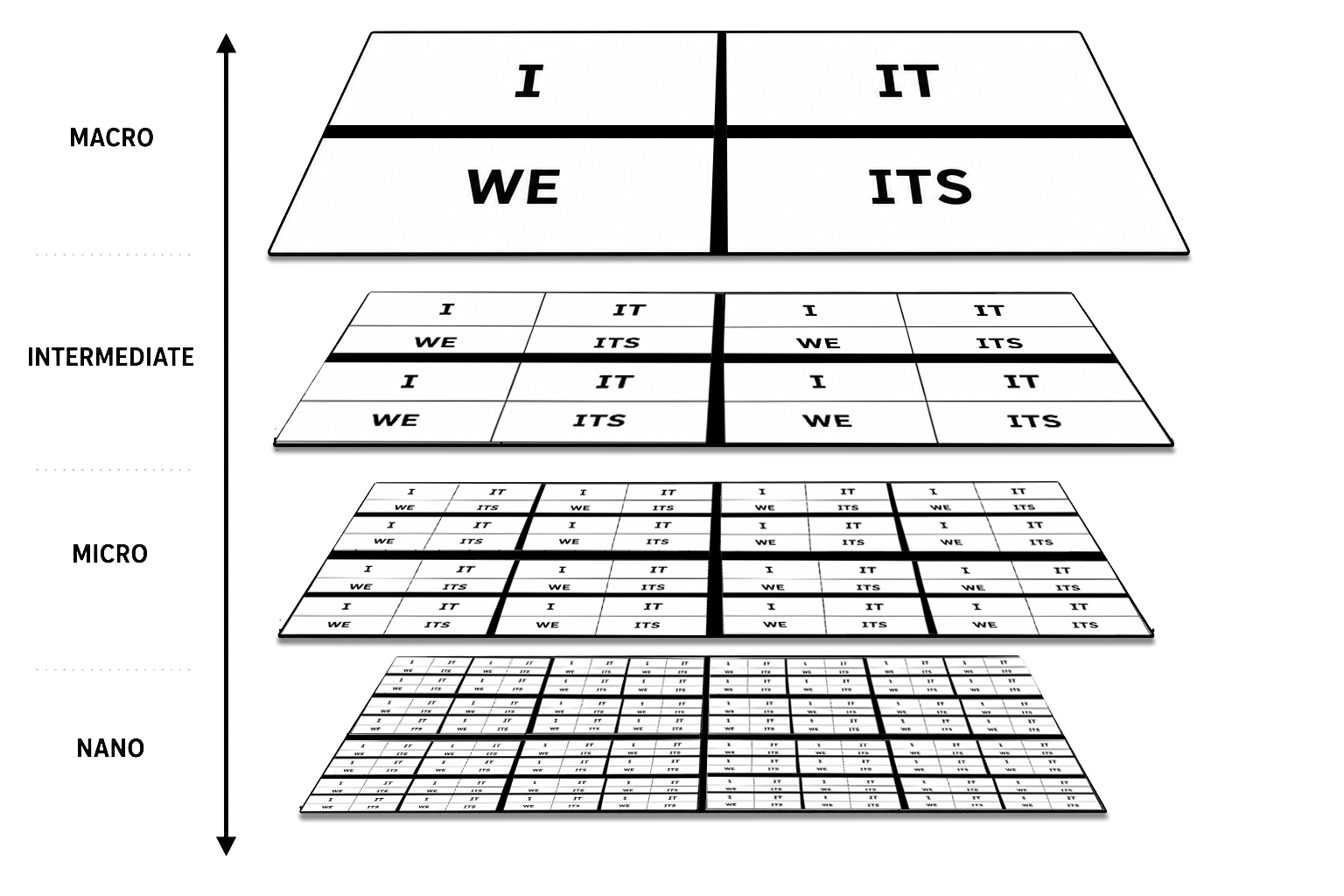
Beginning with the broadest overview of Non-Reductionism, we can progressively zoom into every major area of the philosophy. Each map reveals additional detail while remaining connected to the larger framework above it. As we continue zooming in, each quadrant gives rise to further maps, those maps contain additional quadrants, and those quadrants can themselves be explored at increasingly finer levels of organization.
This creates what might be described as maps within maps and quadrants within quadrants.
Rather than existing as isolated diagrams, every map becomes part of a coherent hierarchy. The macro maps provide the broad structure of the philosophy. Intermediate maps organize each major domain. Micro maps explain individual concepts. Nano maps capture the finest distinctions when necessary.
Because every level is explicitly connected to the levels above and below it, the philosophy develops in a remarkably systematic way. Every concept has a place. Every distinction exists within a larger context. Every level inherits its organization from the same underlying ontological framework.
One of the most important consequences of this approach is that it becomes much more difficult to accidentally neglect an important domain.
Traditional philosophical systems often develop unevenly. Some areas receive tremendous attention while others remain largely unexplored. As a result, blind spots accumulate over time, not because anyone intended to ignore them, but because there was no systematic methodology ensuring that every major domain would eventually be developed.
The NRP Macro-Micro Map addresses this problem directly. Because every major area of the philosophy is explicitly mapped, it becomes immediately obvious where development has occurred, where additional work is still needed, and how every part relates to the rest of the system. Rather than growing organically through disconnected ideas, the philosophy develops as an integrated whole.
This also changes how new ideas are generated. Instead of simply adding concepts wherever they seem interesting, the map itself reveals where additional distinctions, methodologies, or applications are still missing. Empty spaces become opportunities for further development, while existing maps help ensure that new ideas remain coherent with the larger philosophical framework.
The result is the first and only genuinely holistic philosophy. Holism is no longer simply the aspiration to "consider everything." It becomes a systematic methodology for organizing knowledge across multiple levels of scale. Every major domain is explicitly represented. Every map is connected to larger and smaller maps. Every concept exists within a broader context. Every distinction can be understood in relation to the rest of the philosophy.
This is one of the most significant practical contributions of Non-Reductionism. Quadratic Zoom introduces the methodology. The NRP Macro-Micro Map demonstrates what becomes possible when that methodology is consistently applied.
One of the strengths of this approach is that it makes the structure of the philosophy visible. Rather than existing as a collection of disconnected ideas, every major domain is explicitly mapped, every map is connected to the larger framework, and every concept can be understood in relation to the rest of the system. This dramatically reduces the likelihood that important domains will be overlooked while making it much easier to identify areas that still need further development.
The result is a genuinely holistic philosophy. Holism is no longer simply the aspiration to "consider everything." It becomes a systematic methodology for organizing knowledge across multiple levels of scale. Every major domain is intentionally represented, every map connects to larger and smaller maps, and every part of the philosophy exists within a coherent conceptual structure.
The NRP Macro-Micro Map shown here illustrates this methodology in practice. It demonstrates how Quadratic Zoom has been systematically applied across the entire philosophical project, with maps nested within maps and quadrants within quadrants at multiple levels of scale.
A full poster-sized version is coming soon and will be available to download for those who would like to explore the complete framework in greater detail.
The natural question after learning Quadratic Zoom is simple:
What happens when we systematically apply this methodology to an entire philosophical project?
The answer is the NRP Macro-Micro Map.
The NRP Macro-Micro Map is the result of deliberately applying Quadratic Zoom to every major domain within Non-Reductionist Philosophy. Rather than treating the Quadrants as a single diagram used occasionally as a checklist, the entire philosophy is organized from the highest levels of abstraction down to its most specific applications using the same underlying ontological framework.
In other words, the philosophy itself has been mapped.
Nested Quadratic Holons & Primacy
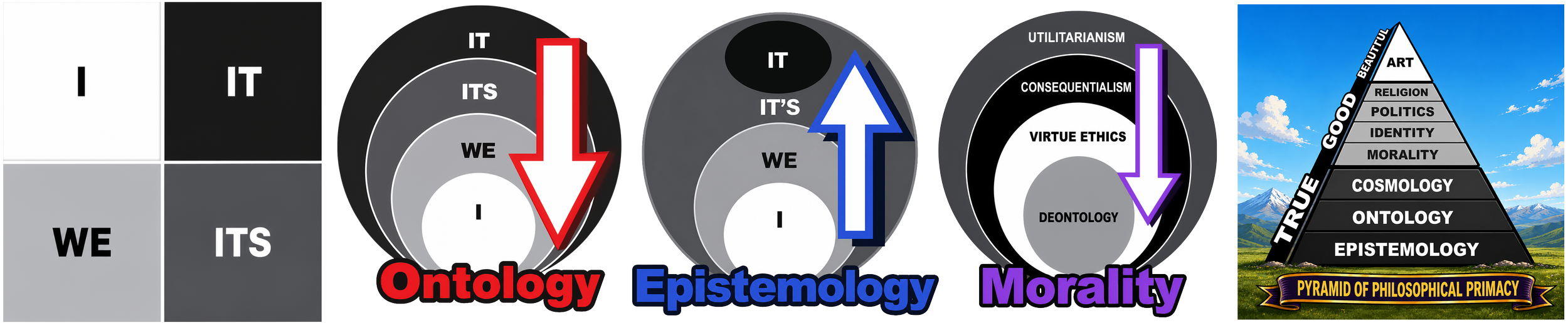
Once we have identified the appropriate level of scale and considered all four ontological zones, another question immediately arises:
How do these quadrants relate to one another?
This is the purpose of Primacy.
The Quadrants are often treated as though they simply divide reality into four equally important categories. While this is useful as an introductory teaching tool, it is not how Non-Reductionism understands their relationship.
Different philosophical projects require different organizations of the Quadrants.
Sometimes one quadrant provides the foundation for the others. Sometimes a particular relationship between quadrants becomes especially important. Sometimes one quadrant serves as the primary source of evidence while the others provide supporting or correlating information. The appropriate organization depends on the question being asked.
This is what Primacy seeks to understand.
Rather than treating the Quadrants as four isolated boxes, Primacy examines the relationships between them and asks how they should be organized to best serve a particular philosophical project.
These context-dependent relationships are represented through Nested Quadratic Holons.
Rather than forcing every project into a single fixed arrangement, Nested Quadratic Holons allow the relationships between the quadrants to be explicitly mapped according to the goals of the project itself. Different projects reveal different patterns of dependence, priority, and interaction while remaining grounded in the same underlying four-quadrant ontology.
This transforms the Quadrants from a simple categorization system into a genuine methodology.
Consider a few examples.
In ontology, the relationships between the quadrants are determined by the structure of reality itself. As we examine the evidence, we find that exterior reality exist before the interiors emerge from them. Understanding these relationships allows us to construct a more coherent account of reality while avoiding the mistake of projecting subjective experience all the way down and back and onto things that do not possess it.
In epistemology, the relationships between the quadrants help us understand how knowledge itself is possible. Before we can ask what counts as good evidence, we must first understand the relationship between subjective experience, other minds, shared meaning, and the external world. Questions about perception, consciousness, objectivity, language, and reality all arise here. In this sense, epistemology can be understood as the complement to ontology. While ontology asks what exists, epistemology asks how we come to know it.
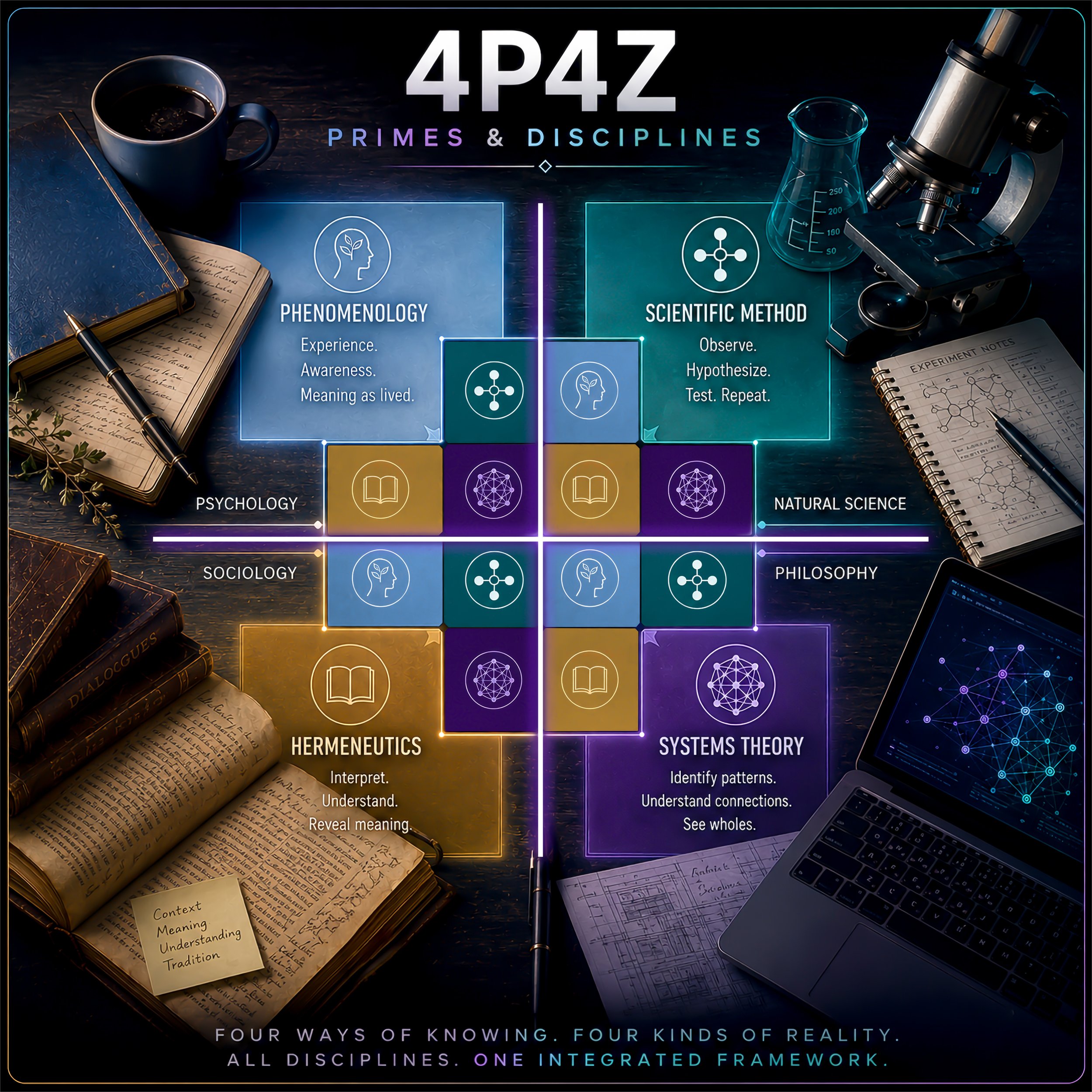
Building upon this broader epistemological foundation, Non-Reductionism introduces 4P4Z, a methodological framework that identifies the primary and secondary methodologies most appropriate for investigating different kinds of phenomena. Rather than assuming every method is equally useful for every question, 4P4Z recognizes that the best methodology depends on the nature of the thing being investigated.
In morality, the relationships between the quadrants again change. The task is no longer to determine what exists or what counts as evidence, but how multiple moral considerations should be integrated into a coherent ethical framework.
Even the overall structure of the philosophy reflects this principle. The Pyramid of Philosophical Primacy organizes philosophy according to the logical dependencies between different philosophical projects, recognizing that some questions must be addressed before others can be answered coherently.
The important point is not the specific organization used in any one project. It is the recognition that different projects require different organizations.
This is one of the most significant methodological contributions of Non-Reductionism.
The Quadrants identify the major ontological zones.
Quadratic Zoom identifies the appropriate level of scale.
Primacy determines how those quadrants should be organized and prioritized for the project at hand.
Together, these ideas transform the Quadrants from a static framework for categorizing reality into a dynamic methodology for investigating it.
Conclusion
The Quadrants have long been recognized as one of the most useful tools for holistic thinking. By distinguishing the fundamental aspect of reality they help us avoid many of the most common forms of reductionism and provide a simple framework for understanding complex phenomena.
Non-Reductionism builds upon this foundation by expanding both the conceptual depth and practical application of the Quadrants.
Rather than treating them as a static categorization system or a simple checklist, Non-Reductionism understands the Quadrants as maps of ontology. This makes it possible to systematically apply them across multiple levels of scale through Quadratic Zoom, organize an entire philosophical project through the NRP Macro-Micro Map, and understand the relationships between the quadrants through Primacy and Nested Quadratic Holons.
Together, these additions transform the Quadrants into a far more rigorous methodology for holistic thinking. They help us determine not only what aspects of reality should be considered, but also what level of scale we should be examining, how those aspects relate to one another, and how they should be organized and prioritized for the particular philosophical project we are undertaking.
The result is a framework that is both more comprehensive and more practical. It provides a systematic way to organize knowledge, reduce blind spots, avoid reductionism, and analyze complex problems without confusing different levels of organization or different kinds of reality.
Most importantly, these ideas work together. Quadratic Zoom, the NRP Macro-Micro Map, Primacy, Nested Quadratic Holons, and the methodologies built upon them are not isolated contributions. They form an integrated framework in which each concept reinforces the others, allowing the Quadrants to function not merely as a helpful way of organizing information, but as the foundation of a genuinely holistic philosophy.
This article has introduced the core concepts. The goal of the Non-Reductionist Fundamentals series is to build a solid conceptual foundation by explaining the essential tools of the philosophy one step at a time. Once those foundations are in place, future application-focused work will explore how these same methodologies can be applied across many specific domains.
If you've made it this far, congratulations. You now have a much deeper understanding of the Quadrants than most people who encounter them. More importantly, you understand them not simply as a diagram, but as a rigorous methodology for holistic thinking. Like any good thinking tool, the value of the Quadrants doesn't come from memorizing the framework. It comes from learning to use them in the world. The more you practice applying these ideas, the more naturally you'll begin to recognize the different aspects of reality, the appropriate levels of scale, and the relationships between them.