


Non-Reductionist Philosophy introduces Philosophical Types as a new framework for describing philosophical orientation. Rather than categorizing people by personality, ideology, or developmental stage, Philosophical Types identifies the deeper tendencies that shape how people interpret reality, responsibility, moral priority, and human possibility.
The framework is organized around four dimensions:
Idealist ↔ Naturalist
As it relates to the nature of reality.
Responsibility ↔ Determinism
As it relates to the explanation of human outcomes.
Agentic ↔ Social
As it relates to moral and social priority.
Pessimist ↔ Optimist
As it relates to realistic possibilities for human and social development.
Together, these dimensions provide a compact way of describing the philosophical center of gravity from which a person tends to understand the world.
Of course there are many other philosophical positions. These four are core orientations whose combinations have unusually broad consequences for worldview, strategy, and developmental action and often give rise to many other positions.

Why Philosophical Types?
People can be at roughly the same developmental stage, understand many of the same facts, and even share many of the same values while still repeatedly arriving at different conclusions.
Not every disagreement is therefore a matter of intelligence, knowledge, or developmental capacity. Sometimes people are working with much of the same information but placing greater emphasis on different aspects of it. One person may focus more on individual responsibility while another emphasizes causal conditions. One may prioritize personal autonomy while another prioritizes collective wellbeing. One may see substantial human and social improvement as realistic while another sees stronger limits on what can be changed.
Existing personality systems can describe psychological differences. Political labels can describe ideological commitments. Developmental models can describe changes in complexity, perspective, and value structure. But none of these necessarily captures the philosophical orientation through which a person organizes the same facts, values, and problems.
Philosophical Types is intended to describe that additional layer.
The Four Core Positions:
Idealist ↔ Naturalist
This dimension concerns the fundamental nature of reality. It asks the ontological question: What kind of reality do we actually inhabit, and what is ultimately fundamental within it?
Idealist orientations give fundamental or irreducible explanatory status to mind, consciousness, spirit, supernatural reality, cosmic purpose, or some other mind-like or purposive dimension of existence. Different forms of idealism can look very different from one another. They may include traditional religious supernaturalism, consciousness-first ontology, spiritual monism, cosmic teleology, or philosophical systems in which mind or spirit is treated as more fundamental than the natural world. What unites them within this framework is the claim that reality cannot be fully understood as a natural world within which mind, meaning, and consciousness emerge.
Naturalist orientations understand reality as entirely continuous with nature. Matter, life, mind, consciousness, meaning, culture, and subjective experience all arise within the natural world rather than existing outside it, preceding it, or providing its ontological foundation. Naturalism does not require reducing higher-order phenomena to their simplest physical components. A naturalist can recognize consciousness, culture, meaning, morality, symbolic life, and subjective experience as real emergent phenomena while maintaining that none requires a supernatural or consciousness-first ontology.
This dimension concerns ontology, not epistemology. Naturalism should therefore not simply be equated with empiricism, science, objectivity, or third-person observation, just as idealism should not be equated with phenomenology, intuition, spirituality, or personal experience.
There are correlations between these orientations and particular epistemic preferences. Naturalists are often more likely to privilege scientific and empirical methods when making claims about external reality, while idealists are often more willing to treat phenomenological, contemplative, or personal experience as evidence for ontological conclusions. But these tendencies are not what defines the types.
An idealist can be highly scientifically literate and make extensive use of empirical evidence, while a naturalist can place great importance on phenomenology, introspection, contemplative experience, symbolism, and other first-person forms of knowledge.
The relevant question is not which methods or forms of experience a person values, but what they ultimately believe those methods and experiences reveal about the nature of reality. A naturalist may take a profound mystical experience completely seriously as an experience while rejecting the conclusion that it demonstrates a supernatural realm. An idealist may accept the findings of neuroscience while maintaining that consciousness is nevertheless ontologically fundamental. The disagreement occurs at the level of interpretation and ontology.
The term Idealist is being used here as a broad philosophical family rather than in only one narrow technical sense. Plato, Hegel, Berkeley, traditional theists, contemporary consciousness-first theorists, and modern spiritual philosophers obviously do not hold the same ontology. They are grouped on the same side of this dimension only insofar as they reject a fully naturalistic account of reality and assign fundamental status to mind, spirit, transcendence, supernatural existence, or cosmic purpose.
Unlike the other dimensions, Idealist versus Naturalist is not merely a difference in emphasis between two equally defensible orientations. It concerns competing factual claims about reality. Naturalism reflects the established scientific picture of the world, while idealism remains a culturally and historically influential worldview despite being factually mistaken. The descriptive purpose of Philosophical Types does not require epistemic neutrality between every position it describes.
This creates an important developmental asymmetry. A person can adopt Naturalism at a relatively early developmental stage simply because they were raised in a secular culture, inherited a scientific worldview, or learned to reject supernatural claims without deeply understanding the epistemological reasons for doing so. Naturalism by itself therefore says little about a person's developmental maturity. It can be held simplistically, dogmatically, reductively, or with considerable philosophical sophistication.
Idealism has a different developmental relationship. A person can certainly become intellectually sophisticated while remaining an idealist, and can integrate substantial amounts of science, philosophy, psychology, phenomenology, and contemplative practice.
But genuinely higher integrative development requires progressively incorporating the epistemic achievements of earlier developmental transitions rather than bypassing them. This includes the rational and scientific deconstruction of traditional supernatural explanations, as well as later recognition of the interpretive limits of personal experience and the need to distinguish what is experienced from what can legitimately be inferred about external reality.
For that reason, an ontology that continues to treat consciousness, spirit, supernatural reality, or cosmic telos as fundamentally constitutive of reality eventually reaches a developmental ceiling. It may reinterpret those commitments in increasingly sophisticated language, but sophistication alone does not resolve the underlying epistemic problem.
Higher integration requires preserving whatever psychological, phenomenological, symbolic, ethical, or existential value earlier worldviews contained while relinquishing ontological claims that no longer survive adequate epistemic scrutiny.
Naturalism therefore does not guarantee higher development, but fully integrative higher development ultimately requires Naturalism.
Responsibility ↔ Determinism
This dimension concerns how human outcomes are explained and where the primary leverage for changing them is located. It asks the practical and causal question: When people succeed, fail, behave well, behave badly, develop, or stagnate, should we primarily look to the individual or to the conditions that shaped the individual?
Responsibility-oriented perspectives place greater emphasis on choice, effort, discipline, character, accountability, self-mastery, judgment, and deliberate action. They tend to treat individuals as important causal agents in their own outcomes and therefore focus on what a person can do differently. When something goes wrong, they are more likely to ask whether the person exercised sufficient judgment, effort, restraint, courage, persistence, or responsibility.
Determinist-oriented perspectives place greater emphasis on prior causes and conditioning: biology, temperament, childhood environment, education, culture, economic conditions, incentives, institutions, social norms, historical circumstances, developmental opportunities, and larger systems. They tend to interpret behavior as the result of causal processes acting through a person rather than as something that can be adequately explained by appealing to choice alone. When something goes wrong, they are more likely to ask what conditions produced the outcome and what would need to change for a different outcome to become more likely.
This dimension is therefore not simply about whether individuals matter. A determinist can believe that discipline, effort, therapy, education, reflection, and deliberate self-development are extremely important. The difference is that these are understood as causal processes operating within a determined system. Encouraging responsibility may itself be one of the conditions that helps produce better outcomes. From this perspective, responsibility can be instrumentally valuable without functioning as an ultimate explanation.
Likewise, a responsibility-oriented thinker does not have to deny the influence of biology, environment, institutions, or circumstance. The distinction concerns relative explanatory weight and practical emphasis. Two people may agree that both individual effort and social conditions matter while differing substantially over which side usually deserves greater attention.
This is why the dimension should not be confused with the philosophical debate over free will and determinism. Someone can reject libertarian free will and still be strongly responsibility-oriented if they believe that emphasizing self-discipline, accountability, character, and deliberate action is the most useful way to understand and improve human behavior. Conversely, someone can believe in some form of free will while still being strongly determinist-oriented in social analysis because they think outcomes are overwhelmingly shaped by structural and environmental conditions.
The distinction also has an important intervention dimension. Responsibility-oriented perspectives tend to direct change efforts toward the person: develop better habits, make better choices, exercise more discipline, build character, take ownership, or become more capable. Determinist-oriented perspectives tend to direct change efforts toward the conditions surrounding the person: improve education, redesign incentives, reduce harmful environmental pressures, change institutions, alter developmental environments, or restructure systems.
Neither orientation necessarily entails blame or compassion. Responsibility can be emphasized harshly or compassionately, and determinism can be used either to understand people more deeply or to dismiss their agency entirely. The dimension is not measuring emotional attitude. It is measuring where a worldview tends to locate explanation, causation, and leverage for change.
At the deepest level, the contrast can be summarized as two different default questions:
Responsibility: What could this person do differently?
Determinism: What produced this person and this outcome in the first place?
Both questions can be valid. Philosophical Types is concerned with which question tends to organize the larger explanatory framework.
Agentic ↔ Social
This dimension concerns moral and social priority. It asks the normative question: When individual and collective interests come into tension, what should receive the greater organizing priority?
Agentic orientations place greater emphasis on autonomy, liberty, individual rights, self-direction, personal flourishing, independence, and the protection of individual agency. They tend to view the individual as the primary bearer of value and to be especially concerned with protecting people from coercion, excessive social control, conformity, or institutions that subordinate individual lives to collective goals.
Social orientations place greater emphasis on collective wellbeing, solidarity, shared goods, social responsibility, cooperation, mutual obligation, and the health of the larger community or system. They tend to view individuals as deeply embedded within social relationships and institutions, and therefore place greater emphasis on the conditions required for communities, societies, and collective systems to function well.
This dimension is not simply about whether someone cares about individuals or cares about society. Nearly any developed philosophy will care about both. The distinction concerns which side tends to provide the larger moral frame within which the other is interpreted.
An Agentic orientation can recognize that healthy communities, institutions, and relationships are necessary for individuals to flourish. A Social orientation can strongly defend personal liberty, rights, creativity, and self-development. What matters is whether collective arrangements are primarily justified by the way they protect and enable individuals, or whether individual flourishing is primarily understood as something that should contribute to and occur within the wellbeing of the larger social whole.
This is also different from Responsibility versus Determinism. Responsibility/Determinism concerns causal explanation and practical leverage: why outcomes happen and where intervention should be directed. Agentic/Social concerns moral and political priority: what those interventions are ultimately meant to protect, promote, or serve.
Because these are separate dimensions, combinations that are often treated as contradictory are entirely possible. Someone can be strongly Responsibility-oriented and Social, believing that individuals should cultivate discipline, accountability, and character while also holding substantial obligations to the wider community. Someone can also be strongly Determinist-oriented and Agentic, explaining behavior primarily through biology, environment, incentives, and institutions while nevertheless regarding individual liberty and autonomy as the highest political values.
The distinction therefore should not be reduced to familiar political binaries such as individualism versus collectivism, capitalism versus socialism, or right versus left. Those ideologies combine many different philosophical commitments. Agentic/Social is narrower. It identifies the moral center of gravity beneath those commitments.
This dimension also concerns how the relationship between the individual and the collective is structured. An Agentic philosophy tends to ask how society can avoid unnecessarily constraining the individual and create space for self-direction. A Social philosophy tends to ask how individuals can participate in, contribute to, and be supported by a healthy collective order.
At the deepest level, the contrast can be summarized as two different organizing questions:
Agentic: How should society protect and enable individual agency and flourishing?
Social: How should individuals and institutions contribute to collective wellbeing and the health of the larger whole?
Neither question excludes the other. Philosophical Types is concerned with which tends to function as the larger normative frame when priorities must be organized or conflicts must be resolved.
Pessimist ↔ Optimist
This dimension concerns what a person believes is realistically possible for human development, society, and civilization. It asks how much meaningful transformation a person thinks is actually achievable given human nature, existing conditions, and the kinds of leverage available to us.
Pessimistic orientations place greater emphasis on enduring limitations, conflict, corruption, irrationality, failure, stagnation, regression, and the rarity or fragility of substantial development. They tend to believe that meaningful human or social transformation is highly constrained, unlikely, or not realistically worth organizing around. Human beings, institutions, and societies are seen as too limited by recurring psychological tendencies, entrenched incentives, power struggles, scarcity, coordination problems, cultural inertia, or developmental ceilings for major improvement to be a credible expectation.
This does not necessarily mean that pessimists believe no improvement is possible at all. They may support local reforms, personal development, harm reduction, or limited institutional improvements. The deeper orientation is that large-scale transformation should be approached with skepticism because efforts to substantially improve people or society are expected to fail, regress, be co-opted, or produce unintended consequences.
Optimistic orientations place greater confidence in development, learning, institutional improvement, technological and cultural progress, better education, improved social design, and the possibility of creating substantially healthier human and social conditions. They tend to believe that meaningful transformation is realistically achievable and therefore worth pursuing.
Human outcomes are seen as sufficiently responsive to education, developmental environments, institutions, incentives, technology, culture, coordination, knowledge, and deliberate intervention that substantially better forms of individual and collective life can actually be built. Optimism therefore involves more than hope. It reflects a belief that there is enough practical leverage in the world for sustained transformative effort to make sense.
This dimension is not simply a measure of mood, temperament, positivity, or emotional hopefulness. A cheerful person can hold a deeply pessimistic philosophy of humanity, while a serious, critical, or even angry person can be philosophically optimistic if they believe that meaningful improvement is realistically achievable. Likewise, optimism does not require believing that progress is automatic, easy, inevitable, or historically guaranteed. Someone can be acutely aware of present failures and still believe that better futures can be deliberately created.
The distinction is therefore about expectations of practical possibility. It concerns what a person believes individuals, institutions, societies, and civilizations are actually capable of becoming, and whether major efforts toward transformation are likely enough to succeed to be worth pursuing.
This orientation can also vary by scale and time horizon. Someone may be optimistic about individual development but pessimistic about mass social change, or pessimistic about current institutions while optimistic about long-term civilizational transformation. Philosophical Types therefore identifies the larger center of gravity rather than requiring uniform optimism or pessimism across every domain.
Pessimism and optimism can also strongly influence the practical expression of the other dimensions. If large-scale transformation appears unrealistic, it may make more sense to focus on individual discipline, resilience, self-overcoming, or the cultivation of exceptional people who can function well within an unhealthy world. If broad improvement appears achievable, then changing institutions, developmental environments, incentives, education, technology, and collective systems becomes a much more plausible strategy.
This is one reason the Pessimist/Optimist dimension can have major consequences. It helps determine not only what future a person expects, but also which forms of action they consider worth investing in.
Pessimist orientations therefore tend toward the position that meaningful transformation is too constrained, unlikely, or fragile to serve as the basis for ambitious social or developmental projects.
Optimist orientations tend toward the position that meaningful transformation is realistically possible, that human beings and societies can be substantially influenced by the conditions we create, and that there is enough leverage available to make serious efforts toward improvement worthwhile.
The core distinction is ultimately about whether a person believes there is enough real power, influence, knowledge, technology, social leverage, and developmental possibility in the world for substantial improvement to be both achievable and worth the effort.
How the Dimensions Combine
The four dimensions are intended to be independent rather than fixed philosophical packages. Although some combinations may be more common than others, one position does not automatically determine the rest.
A person can be:
Naturalist + Responsibility-oriented
They may reject supernatural explanations while still placing strong emphasis on discipline, accountability, self-mastery, and personal responsibility.
Determinist + Agentic
They may see human behavior as causally conditioned while still placing a high moral value on individual liberty, autonomy, and rights.
Idealist + Social
They may hold a spiritual or consciousness-first worldview while prioritizing communal wellbeing, solidarity, or collective obligations.
Naturalist + Pessimist
They may understand reality naturalistically while remaining doubtful about the possibility of substantial human or social improvement.
The dimensions are therefore independent, but not isolated. When two positions are combined, they can produce a recognizable orientation with practical consequences that are not fully captured by either position alone. These interactions become especially important when examining how a person approaches development, morality, social organization, improvement, and flourishing.
Because each dimension contributes independently, the framework can be expressed as a four-letter type. For example:
NDSO
Naturalist, Determinist, Social, Optimist
IRAP
Idealist, Responsibility-oriented, Agentic, Pessimist
NRAP
Naturalist, Responsibility-oriented, Agentic, Pessimist
The purpose of these four-letter types is to provide a shorthand for the dominant philosophical pattern that tends to organize a person’s worldview. They do not imply that everyone with the same type holds the same beliefs, theories, politics, or values.
People can also meaningfully integrate both sides of a dimension. A socially oriented person can strongly defend individual rights. A determinist can believe that personal responsibility is socially necessary. A naturalist can recognize the importance of subjective experience without treating consciousness as metaphysically fundamental. An optimist can remain highly realistic about present limitations and the possibility of failure.
The question is therefore not whether someone completely rejects one side of an axis. It is which side tends to function as the dominant organizing frame.
In more integrated worldviews, one pole is often nested within the other rather than excluded. The type identifies that larger philosophical frame.
A complete type therefore tells us more than which four positions a person tends to emphasize. Those four positions also interact in six different pairings, each of which can reveal a distinct philosophical orientation and strategy. These pairwise relationships are developed later in the framework.
How Philosophical Types Are Structured:
Philosophical Types can be understood at four different levels. Each level adds more information about how a person’s worldview is organized, moving from basic philosophical positions to the complete four-letter type.
Core Philosophical Positions are the eight basic poles that make up the system: I, N, R, D, A, S, P, and O. These represent the individual philosophical positions someone can hold across the four dimensions: Idealist or Naturalist, Responsibility-oriented or Determinist, Agentic or Social, and Pessimist or Optimist.
When two dimensions are considered together, they create a philosophical lens. There are six possible lenses because each of the four dimensions can be paired with each of the other three. Each lens asks a different kind of question about how two positions interact. For example, one lens may examine how ontology affects a person’s understanding of agency, while another examines where they locate leverage for change and how much transformation they believe is possible.
Within these six lenses are 24 Philosophical Orientations. An orientation is the specific combination produced by two positions within a particular lens, such as IR, ND, RA, DO, or SO. These orientations are more than shorthand. When two positions interact, they can produce a recognizable philosophical tendency that is not fully captured by either position on its own. For example, Responsibility and Pessimism together can produce an emphasis on resilience, self-reliance, and self-overcoming, while Determinism and Optimism can produce an emphasis on redesigning the conditions that shape human outcomes.
Finally, a Philosophical Type combines one position from each of the four dimensions into a complete four-letter configuration. There are 16 possible types, such as NDSO, NRAP, IRAP, or IDSO. Each type contains six orientations at once because its four positions can be paired in six different ways.
Each orientation captures a recurring relationship between two positions. The practical strategies associated with these orientations are developed in the following section.
The structure can therefore be summarized as:
8 Core Philosophical Positions → 6 Philosophical Lenses → 24 Philosophical Orientations → 16 Philosophical Types
This allows the same four-letter type to be examined from several different philosophical angles. Two people may share one orientation while differing sharply on another, helping explain why thinkers can resemble one another in one domain while remaining fundamentally opposed in another.
These orientations should not be understood as fixed doctrines or predetermined outcomes. People can share the same orientation while applying it toward very different goals, institutions, domains, or problems. Each orientation describes a recurring relationship between two philosophical positions, while its particular expression is shaped by the other positions and orientations within the person’s full type.
Philosophical Strategies:
The 24 Philosophical Orientations can also be understood as 24 recurring philosophical strategies. A strategy is more than a restatement of the two positions that produce it. It describes the characteristic practical response that tends to follow from combining those positions: what a person tries to do, where they direct their effort, what they protect or change, and why.
For example, Responsibility and Pessimism do not merely describe someone who emphasizes personal responsibility and expects limited improvement. Together they produce a recognizable strategy of Personal Fortification: strengthening the individual to function effectively within conditions that are expected to remain difficult. Determinism and Optimism similarly produce Systemic Transformation: using or redesigning the systems that shape outcomes because substantial improvement is believed to be realistically achievable.
The same concrete action can also express different strategies depending on the philosophical logic behind it. Improving education, for example, might be used to expand individual opportunity, reform the conditions constraining personal autonomy, redesign developmental systems, transform society, or develop collective capacity. The strategy is defined by the reasoning organizing the action, not by the action alone.
These strategies are tendencies rather than fixed prescriptions. Their expression changes according to the other positions in a person’s full type, as well as the particular domain, context, and scale in which they are being applied.
Agency Model:
Idealist/Naturalist × Responsibility/Determinism
This lens concerns how a person’s ontology combines with their understanding of human causation, responsibility, and development.
IR — Idealist + Responsibility:
Personal Ritualistic Practice
Human beings are understood as having some relationship to a higher, spiritual, transcendent, purposive, or consciousness-based reality, while substantial emphasis is placed on what the individual must do to develop, awaken, improve, or fulfill that potential.
This often appears as spiritual discipline, moral cultivation, purification, enlightenment, self-transcendence, salvation, contemplative practice, or deliberate ascent toward a higher state. The individual is expected to participate actively in their own transformation rather than simply being carried along by external conditions.
As a strategy, Personal Ritualistic Practice directs the individual toward deliberate practices believed to bring them into better alignment with, greater awareness of, or closer realization of the idealistic reality they believe exists. The emphasis is on personally doing the practices thought to produce transformation, whether through meditation, prayer, fasting, contemplation, purification, disciplined conduct, initiation, or other symbolically or spiritually interpreted activities.
Example: A spiritual developmental philosophy that tells people they must engage in sustained contemplative practice and personal growth in order to reach higher stages of consciousness.
ID — Idealist + Determinism:
Supernatural Surrender
Human beings are understood as embedded within larger spiritual, purposive, consciousness-based, historical, or transcendent processes that significantly shape who they become.
Development is therefore interpreted less as an isolated act of personal will and more as participation in a larger unfolding order. Depending on the worldview, this could involve divine providence, karma, Spirit, cosmic purpose, developmental forces, or some larger consciousness process.
As a strategy, Supernatural Surrender places less emphasis on personally producing development and more on trusting, yielding to, aligning with, or participating in the larger process believed to be doing the deeper shaping. The individual may still act, practice, or make choices, but these are understood primarily as ways of cooperating with a supposedly greater force or order rather than independently generating transformation through personal effort.
Example: A philosophy in which individual and social development are understood as expressions of a larger supernatural process believed to shape how development unfolds.
NR — Naturalist + Responsibility:
Practical Self-development
Human beings are fully natural beings, but considerable emphasis is placed on their capacity for discipline, deliberate action, character development, judgment, self-mastery, and personal responsibility.
Development means deliberately cultivating the capacities of a natural human being through learning, practice, discipline, reflection, experience, and the development of greater skill, judgment, integration, autonomy, and effectiveness.
As a strategy, Practical Self-Development focuses on concrete methods through which individuals can intentionally improve their capacities and functioning. This can include education, training, habit formation, therapy, reflection, physical practice, emotional regulation, skill-building, disciplined routines, and other practical interventions aimed at increasing competence, resilience, judgment, autonomy, or effectiveness.
Example: A philosophy that encourages people to improve their abilities, judgment, discipline, and independence through education, practice, reflection, skill-building, and other concrete forms of self-development.
ND — Naturalist + Determinism:
Developmental Systems Design
Human beings are understood as entirely natural and as products of causal processes such as biology, psychology, upbringing, education, culture, incentives, institutions, developmental environments, and historical conditions.
Behavior and development are therefore explained primarily by examining the causes that produced them. Individual action still matters, but it is itself understood as part of the causal system rather than as something standing outside it.
As a strategy, Developmental Systems Design focuses on shaping the environments, institutions, incentives, educational systems, cultural conditions, and developmental structures that influence how people develop over time. The strategy seeks to design those conditions so that healthier capacities, behaviors, and developmental outcomes become easier, more likely, and more widely distributed.
Example: Explaining differences in educational achievement by examining childhood development, school quality, incentives, economic conditions, culture, and other causal influences rather than primarily attributing them to willpower.
Value Grounding:
Idealist/Naturalist × Agentic/Social
This lens concerns how a person’s ontology combines with what they ultimately prioritize morally.
IA — Idealist + Agentic:
belief protection
Individual autonomy, personal development, realization, or flourishing is given strong moral importance within an idealistic worldview.
The individual may be understood as possessing a soul, spiritual essence, unique consciousness, divine significance, or personal path toward realization. Because this path is regarded as personally significant, considerable importance may be placed on allowing individuals to hold, explore, and practice their own beliefs without excessive interference from social or institutional authority.
As a strategy, Belief Protection seeks to preserve the individual’s freedom to pursue their own religious, spiritual, consciousness-based, or otherwise idealistic beliefs and practices. The emphasis is less on organizing society around a shared doctrine and more on protecting personal freedom of conscience, interpretation, practice, and individual spiritual pursuit.
Example: A worldview that strongly protects freedom of conscience, belief, interpretation, and personal practice because each individual is believed to have their own relationship to a spiritual, consciousness-based, divine, or otherwise idealistic reality.
IS — Idealist + Social:
Dogmatic Social Order
Collective wellbeing, community, shared purpose, or social order is prioritized within an idealistic worldview.
The community may be understood as participating in a divine purpose, spiritual unity, cosmic order, collective consciousness, revealed morality, or some other supposedly higher structure of meaning. Individual interests are therefore interpreted within a larger moral order believed to apply to the community as a whole.
As a strategy, Dogmatic Social Order seeks to organize collective life around those idealistic beliefs. Religious teachings, moral doctrines, traditions, institutions, laws, or communal expectations may be used to preserve what is regarded as the correct social order and to orient individuals toward its shared values and purposes.
Example: A religious society that structures social duties, institutions, and communal norms around a shared doctrine believed to express the proper moral order.
NA — Naturalist + Agentic:
Autonomy Protection
Individual autonomy and flourishing are prioritized within a naturalistic understanding of human existence.
People are understood as conscious beings with interests, preferences, capacities, relationships, projects, and lives that can go better or worse. Freedom, rights, self-direction, creativity, experimentation, and personal development are therefore valued because they allow individuals greater control over the shape and direction of their own lives.
As a strategy, Autonomy Protection seeks to preserve the individual’s ability to make meaningful choices and direct their own life. This can involve protecting freedom of thought, expression, lifestyle, bodily autonomy, association, personal development, and other forms of self-direction while resisting institutions or social arrangements that unnecessarily subordinate individuals to collective authority.
Example: A philosophy that strongly protects freedom of thought, lifestyle choice, self-expression, and personal decision-making because people should have substantial control over how they live their own lives.
NS — Naturalist + Social:
Collective Flourishing Design
Collective flourishing is prioritized within a naturalistic understanding of human existence.
Human beings are understood as deeply social and interdependent organisms whose wellbeing depends on relationships, institutions, culture, cooperation, education, ecological conditions, economic arrangements, and other shared systems. Individual flourishing therefore occurs within social environments that can either support or undermine human wellbeing.
As a strategy, Collective Flourishing Design seeks to deliberately improve the shared conditions under which people live. Institutions, communities, infrastructure, education, culture, incentives, public systems, and patterns of cooperation can be designed or improved so that healthier, more stable, and more mutually beneficial outcomes become possible across the population.
Example: A philosophy that prioritizes building healthy communities, effective institutions, strong education, social cooperation, and other shared conditions that allow people and societies to flourish together.
Worldview Horizon:
Idealist/Naturalist × Pessimist/Optimist
This lens concerns what kind of reality a person believes exists and what they believe is realistically possible within it.
IP — Idealist + Pessimist:
personal Escape
Reality is understood as containing some higher, spiritual, purposive, consciousness-based, or otherwise idealistic dimension, while ordinary human existence and worldly society are regarded as deeply limited.
Because substantial transformation of the world is considered unlikely, attention may shift toward salvation, liberation, detachment, preparation for an afterlife, reincarnation, spiritual release, withdrawal from ordinary worldly concerns, or the cultivation of a relatively small number of exceptional practitioners.
As a strategy, Personal Escape focuses on securing some form of release, liberation, salvation, or withdrawal for the individual from the limitations of ordinary human existence.
Example: A worldview that treats ordinary life as fundamentally limited and directs individuals toward liberation, spiritual realization, detachment, or some other form of release from the ordinary condition.
IO — Idealist + Optimist:
Proselytization
Reality is understood as containing some higher, spiritual, purposive, consciousness-based, or otherwise idealistic dimension, and substantial human transformation toward that supposed possibility is believed to be achievable.
This can generate expectations of widespread awakening, spiritual development, collective enlightenment, divine fulfillment, historical realization of Spirit, expansion of consciousness, or some other large-scale transformation of humanity.
As a strategy, Proselytization seeks to spread the worldview, teaching, practice, or message so that increasing numbers of people adopt it and participate in the expected transformation. This may take the form of preaching, teaching, conversion, recruitment, movement-building, philosophical outreach, spiritual instruction, or attempts to “awaken” others to what is believed to be a deeper truth.
Example: A movement that believes humanity can undergo a large-scale awakening or realization and therefore focuses on teaching, organizing, recruiting, and spreading the ideas and practices believed to produce that transformation.
NP — Naturalist + Pessimist:
damage control
Human beings and societies are understood as natural systems subject to persistent constraints such as aggression, competition, scarcity, tribalism, irrationality, status conflict, institutional fragility, ecological pressures, cognitive limitations, and uneven developmental capacity.
These constraints are treated as durable enough to significantly limit the scale and reliability of human and social improvement.
As a strategy, Damage Control focuses on containing predictable problems, reducing harm, preserving stability, strengthening safeguards, managing risk, and preventing persistent human limitations from producing severe or systemic consequences.
Example: A philosophy that treats conflict and self-interest as persistent features of human life and therefore emphasizes strong institutions, safeguards, risk reduction, and stability.
NO — Naturalist + Optimist:
progress design
Human beings and societies are understood as natural systems with substantial capacity for learning, adaptation, innovation, cooperation, development, and institutional improvement.
Science, knowledge, education, technology, developmental environments, institutional design, culture, incentives, and coordination provide meaningful leverage for improving human and social outcomes.
As a strategy, Progress Design identifies the causal conditions that produce outcomes and deliberately improves them through experimentation, education, technology, institutional reform, developmental systems, and coordinated problem-solving.
Example: A philosophy that uses advances in education, technology, institutional design, developmental science, and social coordination to create healthier people and more capable societies.
Social Strategy:
Responsibility/Determinism × Agentic/Social
This lens concerns where intervention should primarily be directed and whose flourishing that intervention should ultimately serve.
RA — Responsibility + Agentic:
Self-Reliance
The individual is both the primary site of intervention and a major locus of moral value.
The emphasis tends toward self-direction, discipline, ownership, competence, independence, character, and freedom. Better outcomes are expected to come largely from individuals developing the capacities needed to manage their own lives effectively and pursue their own goals.
As a strategy, Self-Reliance focuses on strengthening the individual’s ability to act independently, solve problems, take responsibility, develop competence, and reduce unnecessary dependence on others or larger systems. The person is expected to become increasingly capable of directing their own life through judgment, discipline, skill, and personal initiative.
Example: A philosophy that encourages people to become disciplined, competent, resourceful, and responsible so they can direct their own lives and pursue their own conception of flourishing.
RS — Responsibility + Social:
Responsible Contribution
Personal development and responsibility are emphasized within a larger commitment to collective wellbeing.
Individuals are expected to cultivate competence, reliability, discipline, character, judgment, and useful capacities so that they can contribute meaningfully to the people, communities, and systems of which they are a part.
As a strategy, Responsible Contribution focuses on developing oneself into someone capable of carrying responsibilities, fulfilling obligations, supporting others, and contributing useful value to the larger whole. Personal development is directed toward becoming a more capable participant in collective life.
Example: A civic philosophy in which people are expected to educate themselves, develop good character, become reliable and capable, fulfill their responsibilities, and use their abilities in ways that benefit the wider society.
DA — Determinism + Agentic:
Condition Reform
Human behavior and personal capacity are understood as strongly shaped by causal conditions, while individual autonomy and flourishing remain the primary moral concern.
Education, economic circumstances, social environments, laws, institutional rules, access to resources, family conditions, incentives, and opportunities can significantly affect how much real control a person has over their own life.
As a strategy, Condition Reform focuses on changing the external conditions that limit or enable individual self-direction. This can involve improving education, expanding access to resources and opportunities, changing restrictive institutional arrangements, reducing avoidable barriers, and creating environments in which individuals have greater real capacity to make meaningful choices for themselves.
Example: Someone who sees poverty, poor education, and harmful environments as major constraints on personal choice and therefore works to improve those conditions so individuals gain greater genuine autonomy.
DS — Determinism + Social:
Social Systems Design
Human outcomes are understood as heavily shaped by systems and conditions, while collective wellbeing receives the larger moral priority.
Institutions, education, culture, economic arrangements, incentives, developmental environments, governance, infrastructure, and social norms all contribute to producing population-level outcomes.
As a strategy, Social Systems Design focuses on deliberately shaping the structures that organize collective life so they produce healthier, more stable, cooperative, and beneficial outcomes across society. The emphasis is on improving the systems that repeatedly influence large numbers of people rather than treating social outcomes as isolated individual events.
Example: A philosophy that redesigns institutions, education, incentives, governance, and other social structures so that healthier outcomes become more likely across the population.
Improvement Strategy:
Responsibility/Determinism × Pessimist/Optimist
This lens concerns where leverage for improvement is thought to exist and how much change that leverage is believed capable of producing.
RP — Responsibility + Pessimist:
Personal Fortification
The individual is understood as the primary site of meaningful leverage, while large-scale human or social improvement is regarded as strongly limited.
Persistent conflict, weakness, irrationality, corruption, scarcity, social instability, or developmental limits are treated as enduring features of the world. The practical emphasis therefore falls on becoming capable enough to function well despite those conditions.
As a strategy, Personal Fortification focuses on strengthening the individual through discipline, resilience, competence, independence, emotional toughness, judgment, and self-command. The aim is to become better able to withstand difficulty, navigate imperfect conditions, and preserve one’s own functioning when broader transformation is unlikely.
Example: A philosophy that encourages people to become strong, disciplined, capable, and self-reliant so they can live well and remain effective in a world that is expected to remain deeply imperfect.
RO — Responsibility + Optimist:
Human Potential Development
The individual is understood as a major source of leverage, and substantial human improvement is considered realistically achievable.
People are seen as capable of becoming significantly wiser, healthier, more skilled, more disciplined, more integrated, or more capable through deliberate effort, education, training, reflection, and development.
As a strategy, Human Potential Development focuses on helping individuals cultivate more of their capacities through education, coaching, practice, character development, skill-building, psychological growth, and other forms of deliberate personal development. Because improvement is regarded as widely achievable, this strategy can scale from individual self-development to large programs designed to help many people realize more of their potential.
Example: A human-development philosophy that invests heavily in education, training, personal growth, and developmental opportunities because large numbers of people are believed capable of becoming substantially wiser, healthier, and more capable.
DP — Determinism + Pessimist:
Systemic Safeguarding
Human beings are understood as strongly shaped by conditions, while the range of improvement those conditions can produce is regarded as significantly constrained.
Persistent tendencies such as self-interest, conflict, status competition, cognitive bias, institutional fragility, coordination problems, and recurring social pressures are expected to remain important even under better conditions.
As a strategy, Systemic Safeguarding focuses on designing institutions, rules, incentives, constraints, redundancies, and protective structures that prevent predictable human limitations from producing severe harm. The emphasis is on stability, risk reduction, containment, institutional resilience, and making systems robust enough to function despite recurring weaknesses.
Example: A philosophy that builds strong institutions, checks, safeguards, and risk controls because people are expected to remain vulnerable to self-interest, bias, conflict, and pressure even within relatively well-designed systems.
DO — Determinism + Optimist:
Systemic Transformation
Human beings and social outcomes are understood as strongly shaped by causal conditions, and those conditions are regarded as sufficiently changeable to support substantial improvement.
Education, institutions, incentives, technology, culture, developmental environments, governance, economic structures, and other systems can therefore become powerful leverage points for changing both individual development and collective outcomes.
As a strategy, Systemic Transformation focuses on altering, redesigning, or using systems in ways that produce substantial improvements in people and society. This can mean transforming the systems themselves, using existing systems as vehicles for transformation, or coordinating multiple systems so that they reinforce better developmental and social outcomes.
Example: A philosophy that substantially improves education, institutions, incentives, developmental environments, and other systems because changing the conditions that shape people is expected to produce correspondingly large improvements in human and social outcomes.
Flourishing Horizon:
Agentic/Social × Pessimist/Optimist
This lens concerns whose flourishing receives greater emphasis and how much flourishing is believed realistically achievable.
AP — Agentic + Pessimist:
Independence Preservation
Individual agency and flourishing are highly valued, while broader social transformation is regarded as strongly limited.
Society is expected to remain imperfect, conflictual, intrusive, unstable, conformist, or otherwise incapable of fully supporting individual flourishing. The practical emphasis therefore falls on preserving enough freedom, privacy, independence, and personal space for individuals to construct worthwhile lives within those conditions.
As a strategy, Independence Preservation focuses on protecting the individual from excessive dependence, coercion, interference, or absorption into collective demands. It seeks to preserve the resources, freedoms, boundaries, and practical independence needed for people to maintain self-direction and live according to their own priorities even within a persistently flawed social environment.
Example: Someone who expects society to remain deeply imperfect but strongly values personal freedom, privacy, independence, and the ability of individuals to build meaningful lives on their own terms.
AO — Agentic + Optimist:
Opportunity Expansion
Individual flourishing is prioritized, and substantial increases in freedom, capability, creativity, mobility, and self-direction are regarded as realistically achievable.
People are understood as capable of doing much more with their lives when they have access to better education, information, tools, technology, resources, rights, networks, and meaningful options.
As a strategy, Opportunity Expansion focuses on increasing the range and quality of possibilities available to individuals. This can involve expanding access to education, economic opportunity, creative tools, mobility, information, technology, social participation, and other conditions that allow people to pursue paths suited to their own interests, abilities, and values.
Example: A philosophy that seeks to expand education, opportunity, mobility, technology, and freedom so that more people can develop their abilities and construct lives that fit their own goals and capacities.
SP — Social + Pessimist:
Social Preservation
Collective wellbeing is prioritized, while human conflict, social fragility, institutional decay, coordination problems, and other limitations are regarded as persistent.
The emphasis therefore falls on preserving the institutions, norms, relationships, shared goods, mutual obligations, and forms of cooperation that allow collective life to remain stable and functional.
As a strategy, Social Preservation focuses on maintaining the social structures that hold communities together and protect them from deterioration. This can include preserving institutional continuity, public goods, social trust, civic norms, mutual support, cultural practices, community ties, and other forms of cohesion that sustain collective wellbeing over time.
Example: Someone who expects conflict and social limitations to remain persistent but strongly supports durable institutions, social trust, mutual obligation, and shared goods that keep communities functioning well enough to endure.
SO — Social + Optimist:
Collective Development
Collective flourishing is prioritized, and substantial improvement in communities, institutions, cooperation, shared capacity, and social organization is regarded as realistically achievable.
Societies are understood as capable of becoming healthier, more coordinated, more knowledgeable, more prosperous, more developmentally supportive, and better able to meet the needs of their members over time.
As a strategy, Collective Development focuses on building the capacities of communities and societies themselves. This can involve improving institutions, education, infrastructure, cooperation, social trust, shared knowledge, public systems, cultural development, and other collective capacities that allow increasingly large groups of people to function and flourish together more effectively.
Example: A worldview that invests in stronger institutions, better education, social cooperation, shared infrastructure, and long-term collective capacity because society is believed capable of becoming substantially healthier and more capable over time.
Recurring Philosophical Clusters:
Although the four dimensions are independent, some combinations reinforce one another strongly enough to form recurring philosophical clusters. These clusters are not fixed packages, but recognizable patterns in which the positions and strategies within a type repeatedly point in compatible directions.
A cluster therefore reflects more than four positions appearing together. Each four-letter type contains six pairwise orientations, and those strategies can reinforce one another into a larger practical pattern. This helps explain why some configurations repeatedly appear across philosophical, religious, political, and cultural traditions.
One likely cluster is:
IRAP
Idealist + Responsibility-oriented + Agentic + Pessimist
This pattern is common in many religious, spiritual, and individualist philosophical traditions. If mind, spirit, or transcendent reality is treated as primary, greater emphasis may also be placed on inner transformation, personal responsibility, self-mastery, salvation, awakening, or moral discipline. These traditions also often place relatively low expectations on large-scale human transformation, treating genuine salvation, enlightenment, or higher development as difficult, rare, or available only to a minority.
At the strategy level, IRAP combines Personal Ritualistic Practice, Belief Protection, Personal Escape, Self-Reliance, Personal Fortification, and Independence Preservation. These strategies repeatedly direct attention toward the individual: personal practice, private belief, individual liberation, self-reliance, resilience, and maintaining independence within a world expected to remain deeply limited.
Another likely cluster is:
NDSO
Naturalist + Determinist + Social + Optimist
This pattern understands people as products of natural, developmental, cultural, and systemic causes. If behavior is strongly shaped by conditions, then changing those conditions becomes a central strategy for producing better outcomes. This can naturally support greater emphasis on social systems, collective wellbeing, and the possibility of improving people and society through better institutions, education, incentives, environments, and cultural structures.
At the strategy level, NDSO combines Developmental Systems Design, Collective Flourishing Design, Progress Design, Social Systems Design, Systemic Transformation, and Collective Development. These strategies repeatedly direct attention toward shaping conditions, improving systems, expanding collective capacity, and deliberately producing broader human and social progress.
The contrast between these clusters can be summarized roughly as:
IRAP: change the person within a difficult world.
NDSO: change the conditions that shape people and the world.
That does not mean every idealist is IRAP or every naturalist is NDSO. Nietzsche, for example, is a naturalist who is strongly responsibility-oriented, agentic, and pessimistic. Hegel is an idealist who is comparatively deterministic, social, and optimistic.
Those exceptions are important because they show that the framework is not simply dividing people into two camps. The dimensions remain independent. But the existence of recurring clusters may help explain why certain philosophical positions, religious traditions, political orientations, and social theories so often appear together.
In this sense, Philosophical Types can do more than describe individual differences. It can also help reveal the larger philosophical patterns that organize whole traditions and worldviews.
The NRP Position: NDSO Synthesis
Philosophical Types is not intended as a neutral personality system in which every configuration is treated as equally adequate. It can be used descriptively to understand philosophers, recurring worldviews, strategic tendencies, and the assumptions different people bring into a discussion. But Non-Reductionist Philosophy has a definite position within the system.
NRP advocates movement toward an NDSO synthesis, with IRAP nested within it.
This does not mean simply rejecting Idealism, Responsibility, Agency, and Pessimism. Each of these poles points toward something that needs to be preserved. The question is which orientation provides the larger frame and which is nested within it.
For NRP:
I is nested within N.
R is nested within D.
A is nested within S.
P is nested within O.
This synthesis is also closely connected to the developmental movement from Yellow/Gold personal integration toward Turquoise collective integration.
Naturalism as the Gate
The strongest line in the sand is between Naturalism and Idealism.
NRP is grounded in Emergent Naturalism. Naturalism and Idealism are not treated as equally plausible ontologies or simply different philosophical preferences. Naturalism is the more adequate account of reality.
The I/N distinction therefore affects how virtually everything else in the philosophy is understood. Two people can appear to agree about ethics, responsibility, society, meaning, or strategy while interpreting all of those things through fundamentally different worldviews.
This is also why idealist metaphysics are incompatible with second-tier development. Second tier comes after rational deconstruction of pre-rational dogma and the further existential and cultural deconstruction associated with Green. It cannot consist in simply reinstalling metaphysical claims that did not survive those critiques.
What can be reintegrated are the legitimate functions those traditions were attempting to serve.
NRP therefore nests I within N.
Through Emergent Naturalism, Sacred Naturalism, Semantic Compatibilism, trans-rational interpretation, and the Trans-Rational Rules of Engagement, NRP retains meaning, purpose, symbolism, mythology, poetry, sacredness, first-person depth, transpersonal experience, and sacred life practice.
These dimensions are not dismissed. They are interpreted in ways that have to cash out in accordance with reality.
The poetic and symbolic remain available without being allowed to override ontology.
For this reason, Naturalism functions as something of a gateway into deeper NRP integration. People may enter the community from many different Naturalist types. An NRAP, NDAP, NRSO, or other N-type may find substantial areas of agreement with NRP and make useful use of the philosophy.
But Naturalism alone is not enough to carry the project into its deeper developmental and strategic work.
Responsibility Nested Within Determinism
NRP treats Responsibility as nested within Determinism.
Human beings are causal organisms. Behavior emerges from biology, development, education, incentives, culture, relationships, institutions, opportunities, habits, environments, and many other interacting conditions.
If we want different outcomes, we therefore have to understand and alter the conditions that help produce them.
This does not eliminate responsibility.
First- and second-person language such as I want, you should, we ought, and I am responsible performs functions that cannot simply be replaced by third-person causal description. Semantic Compatibilism recognizes that these modes of discourse operate at different levels and can each have their own validity.
We can therefore teach responsibility, cultivate it, praise it, expect it, criticize irresponsibility, and ask people to make commitments while simultaneously recognizing that people's capacity for responsible action has causes.
At the personal level, responsibility language can be an important intervention. Someone may need to decide to act, take ownership, develop discipline, change their habits, or create structures in their life that enable better behavior.
But at the systemic level, relying primarily on responsibility becomes inadequate.
If people have never been taught responsibility, if their environment systematically discourages it, and if institutions reward the opposite behavior, simply becoming angry that they are not responsible misunderstands how behavior is produced.
A deterministic frame therefore allows us to ask a more useful question:
What conditions would make responsible behavior more likely?
This is essential for system-building. NRP does not want institutions that work only when everyone behaves exceptionally well. It wants systems designed around realistic causal expectations of human behavior while still encouraging and developing responsible participation within them.
Responsibility is preserved, but Determinism supplies the larger explanatory and strategic frame.
Agency Nested Within the Social
NRP likewise rejects simplistic extremes on the Social/Agentic axis.
A purely Agentic position ignores the degree to which every individual depends upon collective infrastructure, social inheritance, institutions, ecological systems, cooperation, and other people. Extreme individual freedom can also impose costs upon the very systems that make individual freedom possible.
But an extreme Social position can become equally destructive if it suppresses autonomy, individuality, experimentation, creativity, difference, and legitimate personal freedom.
The adequate position therefore has to be a synthesis.
NRP currently advocates Collective Individualism.
Individuals are nested within the collective, while the collective exists partly to cultivate the development, freedom, capabilities, and flourishing of individuals. The system invests in people, and developed individuals return their capacities to the whole.
This does not mean that only one institutional synthesis is possible. Different balances between social provision and individual agency can be explored. But neither extreme can be allowed to undermine the conditions required by the other.
The present emphasis on the Social side is also corrective. Under conditions of extreme individualism, atomization, and the privatization of collective problems, a stronger understanding of the common good and our mutual dependence becomes necessary.
Pessimism Nested Within Optimism
NRP's Optimism does not mean believing that everything will work out.
It means maintaining realistic, optimistic, creative engagement wherever meaningful possibilities for improvement remain.
There are situations in which pessimistic assessments are warranted. Systems can fail. Opportunities can disappear. Some losses may become irreversible. Preparation, resilience, risk analysis, contingency planning, grief, and fallback strategies all have legitimate roles.
NRP therefore does not eliminate Pessimism. It nests it within Optimism.
As long as meaningful possibilities for transformation remain, our primary orientation should be to attempt transformation while remaining realistic about the possibility of failure.
A person does not need to believe that success is likely or guaranteed. It may be enough to recognize that success remains possible enough that surrender would be premature.
The appropriate strategy also depends upon context. The most responsible use of one person's time may be institution-building. For another it may be research, education, family care, community work, creative production, resilience-building, or preparation. Talents, access, obligations, circumstances, and leverage differ.
The larger principle is to assess the situation realistically and then act where our efforts have a credible possibility of producing value.
Yellow and Gold: Personal Integration
This brings the philosophical types into direct relationship with developmental stage.
Yellow and Gold are stages of personal integration.
At these stages, the individual becomes increasingly capable of integrating perspectives, systems, developmental differences, values, knowledge, and contradictions within a more coherent personal worldview.
Someone at Yellow or Gold may therefore be philosophically sophisticated while still holding a variety of Naturalist type configurations.
An NRAP person, for example, may be highly developed personally. They may understand complexity, integrate multiple perspectives, take responsibility for themselves, value autonomy, and realistically recognize serious problems in the world.
That can still be a coherent personal integration.
Yellow and Gold do not yet require the person to make collective system-building their dominant developmental task.
Turquoise: Collective Integration
Turquoise is collective integration.
The developmental task changes.
Turquoise is not simply a person possessing an even more complex private worldview. It is the movement from personal integration into the construction of integrative systems capable of coordinating people, institutions, developmental differences, and the needs of the whole spiral.
Turquoise asks questions such as:
What conditions are producing these outcomes?
How can we redesign those conditions?
How do we build systems that work across different developmental levels?
How do we coordinate individual and collective needs?
How do we create institutions that remain functional even when individuals are imperfect?
How can we use what is available to us to generate better futures?
Once the developmental task becomes collective integration, the philosophical requirements become much more constrained.
A dominant R orientation is insufficient because system-building requires understanding the causes that produce people's behavior rather than merely expecting them to choose correctly.
A dominant A orientation is insufficient because collective integration cannot be built from a philosophy that treats individual agency as primary and collective coordination as secondary. Turquoise is explicitly concerned with organizing and improving systems for the whole.
A dominant P orientation is insufficient because if collective transformation is regarded as fundamentally futile, the Turquoise project stops. The strategy shifts toward retreat, self-protection, adaptation, or survival rather than collective integration.
This does not mean that Responsibility, Agency, and Pessimism disappear at Turquoise.
They are integrated.
Turquoise still needs responsible individuals. It still protects legitimate autonomy and agency. It still anticipates risk, failure, collapse, and unintended consequences.
But these capacities operate inside the larger DSO frame required for collective integration.
And because second-tier integration must also remain grounded in a reality-based ontology, the complete synthesis is NDSO.
N provides the reality-based ontology.
D provides the causal understanding required to design systems that reliably produce better outcomes.
S provides the collective orientation required to integrate individuals, institutions, and developmental differences within a larger whole.
O provides the generative commitment required to continue building while meaningful possibilities for transformation remain.
IRAP remains nested within that structure:
Idealist themes are recovered as trans-rational meaning, symbolism, sacredness, and first-person depth within Naturalism.
Responsibility is preserved as a necessary first- and second-person practice within Determinism.
Agency is preserved as individual freedom and development within Social interdependence.
Pessimism is preserved as realism, risk awareness, preparation, and fallback planning within Optimistic engagement.
The result is NDSO with IRAP nested within it or NDSO Synthesis.
Philosophical Alignment and Participation in NRP
This gives Philosophical Types an important function within the NRP community.
People can enter NRP from many different Naturalist configurations.
Someone may appreciate the theory, participate in discussions, use NRP frameworks in their own work, and gain substantial value from the community without already occupying the full NDSO synthesis.
They are welcome to do so.
But deeper participation in NRP requires more than knowing the theory.
Non-Reductionism is not simply an intellectual framework to understand. It is a project concerned with what we intend to do with that understanding: develop people, build communities, construct institutions, create better systems, and contribute to a wider integrative transformation.
As participation moves toward deeper stewardship and leadership, philosophical and strategic alignment therefore becomes increasingly important.
Someone can remain primarily NRAP and still understand a large amount of NRP at the level of personal integration. But if they remain committed to a Responsibility-first, Agency-first, and Pessimism-first orientation, they will eventually encounter limits in their ability to participate in the collective integration that defines Turquoise.
To move further, they will need to integrate those orientations within DSO.
This is why Philosophical Types is not simply a system for discovering an identity.
It can also show us where the work of integration needs to happen.
If someone discovers that they are not operating from the NDSO synthesis, the point is not merely to say, “That is my type.”
It creates an opportunity to ask why.
What assumptions are producing that orientation? What does that pole correctly perceive? Where does it become reductionistic when treated as primary? What would be preserved if it were nested within the larger synthesis?
These are precisely the kinds of conversations NRP wants to facilitate.
The goal is not complete agreement about every proposal, strategy, institution, or judgment. Once there is sufficient foundational alignment, substantial disagreement should remain. Members and leaders should criticize strategies, challenge assumptions, identify unintended consequences, propose alternatives, and revise the project when better evidence or reasoning demands it.
The purpose of the alignment is not to eliminate disagreement.
It is to establish enough shared philosophical ground that we can engage in collective integration together.
Philosophical Types therefore serves both as a descriptive map and as a developmental tool. It helps us understand where people are starting, recognize the legitimate insights contained within different orientations, identify where those orientations become distorted, and clarify the direction of integration.
For NRP, movement toward that NDSO synthesis is part of the movement from personal integration into collective integration itself.
Nuances and Caveats:
Philosophical Types should not be understood in the same way as personality types.
The framework describes philosophical positions and orientations, not fixed traits, innate temperaments, or claims about how someone's brain is wired. Personality may influence which philosophical positions a person finds more intuitive or attractive, but philosophical types are primarily learned, developed, inherited, examined, revised, and sometimes abandoned.
A person's type can therefore change.
This also means that sharing the same philosophical type does not imply sharing the same developmental maturity or depth of understanding. There is an important difference between a philosophical position that has been inherited and one that has been earned.
People acquire philosophical assumptions from families, religions, educational systems, political cultures, social classes, peer groups, media environments, and the broader societies in which they develop. A person can inherit Naturalism from a secular culture, Responsibility from a culture of self-reliance, Agency from an individualistic society, or Social values from a collectivist environment without ever critically examining those positions.
The same applies to Idealist, Determinist, Pessimist, Optimist, and other orientations. Any philosophical position can be held dogmatically, simplistically, or largely because one's environment made it seem obvious.
An earned position is different. It has survived serious engagement with alternatives, evidence, criticism, internal tensions, and the strongest arguments against it. The person understands not only what they believe but why they believe it, what the position explains, where its limits are, and how valid concerns from competing positions should be integrated.
This distinction is particularly important when relating philosophical type to developmental stage. Being a Naturalist, for example, does not automatically indicate advanced development. Someone may simply have inherited Naturalism without understanding the epistemic reasons for it. What matters developmentally is not merely arriving at a particular answer, but the level of differentiation, critique, integration, and reconstruction through which that answer has been reached.
Philosophical Types therefore identifies a person's current philosophical center of gravity, not their essence and not their developmental achievement.
Context also matters. A person's dominant orientation does not determine every judgment they will make. Someone can emphasize responsibility in one context and causal conditions in another, protect individual agency in one domain and collective welfare in another, or engage pessimistic contingency planning within a broader Optimistic strategy.
For this reason, a philosophical type should not become an identity to defend. It is better understood as a map of where someone currently stands, how they tend to interpret problems, and where further examination or integration may still change their position.
Philosophers as Examples:
The following typings are interpretive applications of Philosophical Types. They are not claims that these thinkers would have described themselves in these terms. The goal is to identify the dominant philosophical positions and strategies that appear across their work. Each four-letter type contains six pairwise orientations, so thinkers can resemble one another in one strategic domain while differing sharply in others. The examples below therefore illustrate both the four core positions and the larger strategic pattern those positions produce when combined.

David Long — NDSO
Naturalist, Determinist, Social, Optimist
David Long’s philosophical position is the NDSO synthesis. His Emergent Naturalism preserves meaning, purpose, sacredness, symbolism, and trans-personal depth through Sacred Naturalism, sacred life practice, Semantic Compatibilism, and trans-rational interpretation, while keeping them grounded in reality. Responsibility is nested within Determinism, individual agency within Collective Individualism, and pessimistic realism and contingency planning within a broader commitment to realistic, optimistic, creative engagement.
Together, these commitments produce the NDSO strategies of Developmental Systems Design, Collective Flourishing Design, Progress Design, Social Systems Design, Systemic Transformation, and Collective Development.

Karl Marx — NDSO
Naturalist, Determinist, Social, Optimist
Marx is naturalist in rejecting supernatural explanations of history and grounding human life in material and social conditions.
He is strongly determinist-oriented in the way he explains consciousness, class behavior, political conflict, and social development through economic structures, historical conditions, and relations of production rather than primarily through individual moral failure.
He is social because the individual is understood as embedded within social relations, class structures, institutions, and collective forms of life.
He is optimistic in the philosophical sense used here because his critique of capitalism is connected to the belief that social structures can be transformed and that different material conditions can produce substantially different forms of human life.
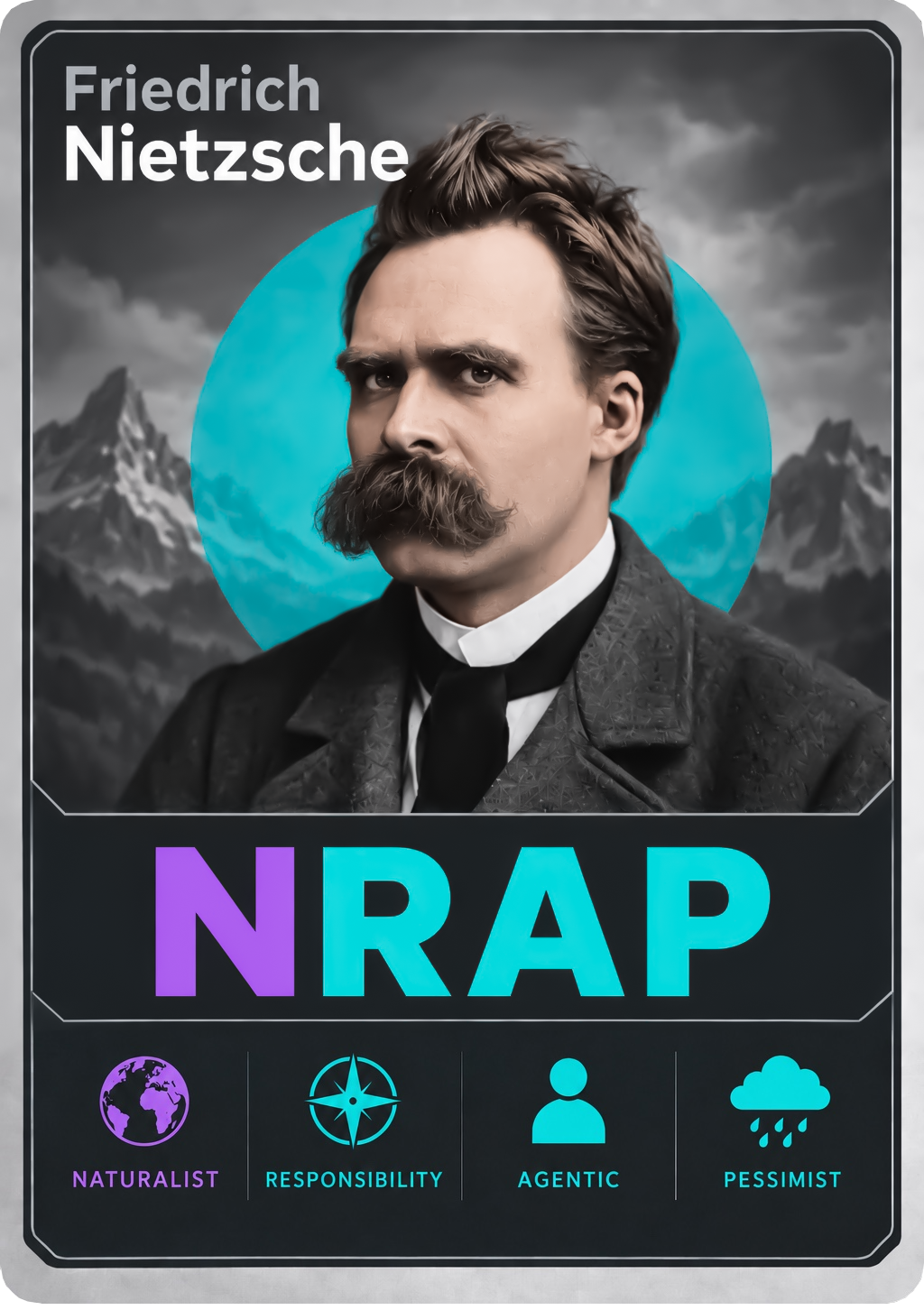
Friedrich Nietzsche — NRAP
Naturalist, Responsibility, Agentic, Pessimist
Nietzsche is naturalist in his rejection of traditional supernatural morality, divine authority, and metaphysical worlds beyond nature.
He is responsibility-oriented because his philosophy repeatedly emphasizes self-mastery, self-overcoming, discipline, strength, character formation, and the capacity of the individual to create values rather than simply inherit them.
He is strongly agentic because his attention is directed toward exceptional individuals, independence, resistance to herd morality, and the cultivation of individual strength in the face of social conformity.
He is pessimistic because he has relatively low expectations for widespread higher development. His work often assumes that genuine self-overcoming and higher forms of human development will remain rare.
Strategically, this produces a pattern of Practical Self-Development, Self-Reliance, Personal Fortification, and Independence Preservation: the individual becomes the main site of development and resilience within a culture expected to remain deeply resistant to higher development.

Ken Wilber / Integral Theory — IRAP
Idealist, Responsibility, Agentic, Pessimist
Wilber is idealist in giving consciousness, spirit, and metaphysical development a fundamental role in his account of reality.
He is responsibility-oriented because significant development is strongly associated with individual practice, self-development, spiritual discipline, and personal transformation.
He is agentic because the developmental project is centered heavily on what individuals can cultivate within themselves, even when culture and systems are included in the framework.
He is pessimistic in developmental terms because higher stages and advanced realization are treated as difficult and relatively uncommon achievements. Large-scale developmental transformation is not generally expected to occur quickly or widely.
Strategically, this produces Personal Ritualistic Practice, Belief Protection, Personal Escape, Self-Reliance, Personal Fortification, and Independence Preservation, placing the developmental emphasis primarily on personal practice, individual realization, and the cultivation of relatively rare higher attainment.

G. W. F. Hegel — IDSO
Idealist, Determinist, Social, Optimist
Hegel is idealist in understanding reality through Geist, or Spirit, and in treating history as part of a larger rational developmental process.
He is determinist-oriented because individuals are embedded within historical, social, institutional, and dialectical processes that are larger than individual choice.
He is social because freedom is realized through ethical life, institutions, family, civil society, and the state rather than through isolated individual autonomy.
He is optimistic because history is understood as a process through which freedom and rational self-understanding become increasingly realized.
Strategically, the combination points toward Supernatural Surrender, Dogmatic Social Order, Proselytization, Social Systems Design, Systemic Transformation, and Collective Development, placing development within a larger historical and social process rather than primarily within individual practice.

Thomas Hobbes — NDAP
Naturalist, Determinist, Agentic, Pessimist
Hobbes is naturalist and mechanistic in treating human beings as part of the causal order of nature.
He is strongly determinist in his explanation of human behavior, emphasizing passions, fear, desire, competition, and causal necessity.
He is agentic in the sense that his political philosophy begins from individuals pursuing their own interests, attempting to preserve themselves, and negotiating the conditions under which they surrender some freedom to political authority.
He is pessimistic because he expects conflict, insecurity, competition, and violence to emerge from ordinary human motivations unless sufficiently strong institutions constrain them.

John Stuart Mill — NRAO
Naturalist, Responsibility, Agentic, Optimist
Mill is broadly naturalist and secular in orientation.
He is responsibility-oriented through his emphasis on education, cultivation, character, intellectual development, and the consequences of individual choices.
He is strongly agentic because individual liberty, freedom of thought, experimentation in living, and protection from unnecessary social interference are central to his philosophy.
He is optimistic because he believes that education, institutional reform, free inquiry, and cultural development can substantially improve human life.

Arthur Schopenhauer — IDAP
Idealist, Determinist, Agentic, Pessimist
Schopenhauer is idealist in distinguishing the world as representation from the underlying Will.
He is deterministic because individual action is ultimately driven by forces deeper than conscious choice. The individual does not simply originate his own desires or character.
He is agentic in focus because the existential problem is centered heavily on what the individual can do in relation to suffering, desire, aesthetic experience, compassion, and renunciation.
He is strongly pessimistic because suffering is treated as deeply rooted in the structure of existence itself rather than as a temporary social condition that can be engineered away.
Strategically, the combination points toward Supernatural Surrender, Personal Escape, and Independence Preservation: the individual is understood as caught within deeper forces and seeks relief through detachment, renunciation, and personal release.

Plato — IRSP
Idealist, Responsibility, Social, Pessimist
Plato is idealist in treating the Forms as more fundamental than the changing world of ordinary experience.
He is responsibility-oriented through his emphasis on cultivation of the soul, virtue, philosophical discipline, education, and moral order.
He is social because individual virtue and social order are deeply connected in his political philosophy. The good life is tied to the proper organization of the polis.
He is pessimistic about widespread philosophical attainment because genuine wisdom is treated as rare, and only a minority are expected to reach the highest forms of understanding.
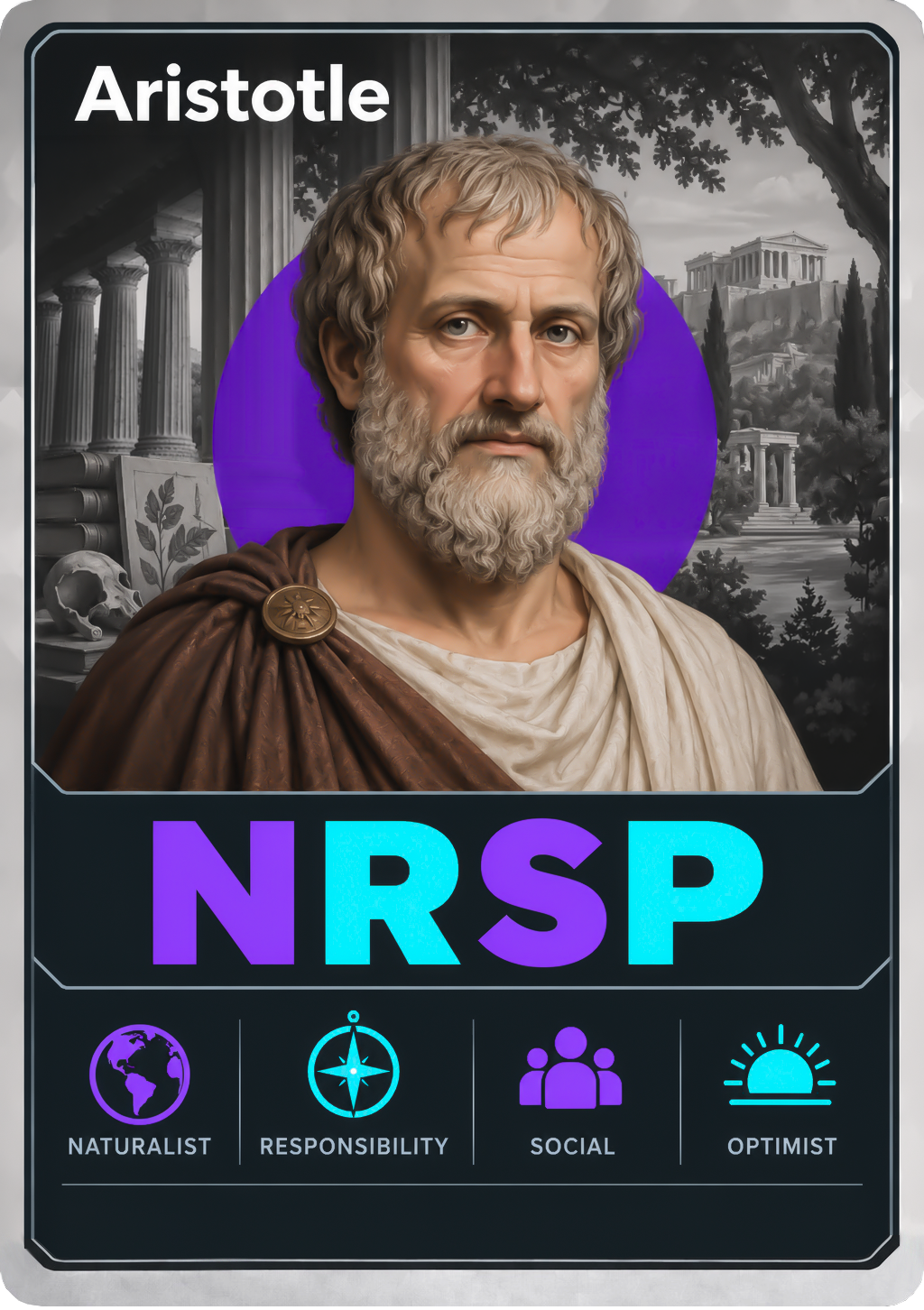
Aristotle — NRSP
Naturalist, Responsibility, Social, Pessimist
Aristotle is broadly naturalist in grounding his philosophy in the study of nature, living organisms, causation, human capacities, and the structures found within the natural world.
He is responsibility-oriented because ethics centers on character, habit, practical wisdom, deliberate action, and the cultivation of virtue.
He is social because human flourishing is inseparable from participation in social and political life. Human beings are political animals, and the polis is part of the conditions that make a good human life possible.
He is comparatively pessimistic, or at least restrained, about transformative possibility. His philosophy focuses more on cultivating excellence within relatively stable features of human nature than on radically transforming humanity or civilization.
What the Comparisons Reveal
David Long’s Non-Reductionist Philosophy
VS Ken Wilber’s Integral Theory
Long / NRP: NDSO
Wilber / Integral Theory: IRAP
This is one of the clearest and most important comparisons in the framework because both Non-Reductionist Philosophy and Integral Theory are broad integrative meta-theories. Both attempt to make sense of development, consciousness, culture, systems, meaning, states, and human transformation. In that sense, they are operating in much of the same philosophical territory.
What separates them is not the range of topics they care about, but the philosophical orientation through which those topics are interpreted.
David Long’s Non-Reductionist Philosophy is Naturalist, Determinist, Social, and Optimist. It begins from the conviction that reality is natural, that human beings are deeply shaped by causes and conditions, that individual flourishing must be nested within collective flourishing, and that large-scale human and social development is realistically possible if better systems, institutions, cultures, and developmental environments can be created.
Ken Wilber’s Integral Theory is Idealist, Responsibility-oriented, Agentic, and Pessimist. It places consciousness and spiritual development in a more metaphysically primary position, gives greater emphasis to personal practice and individual developmental responsibility, centers transformation more heavily in the individual, and holds a comparatively lower expectation that higher development will become widespread. Advanced development remains difficult, rare, and disproportionately associated with exceptional individuals rather than with large-scale social transformation.
On the NRP side, the emphasis falls on real-world transformation. The higher goal of the project is to bring philosophically aligned people together to plan, build, coordinate, and shape actual social conditions. The future being imagined is civic, practical, developmental, and collective. The concern is not spiritual ascent out of the world, but the redesign of the world. Human development is understood as something that can be scaffolded through better environments, better education, better systems, and wiser forms of organization.
On the Integral Theory side, the emphasis falls more on inner ascent and individual attainment. The focus is on consciousness, awakening, levels, higher realization, and the disciplined work of individual development. The Integral community has a more transcendent orientation, where the deepest movement is not primarily the collective reconstruction of society but the upward development of consciousness and the cultivation of the individual self.
So even where the two frameworks use similar language, they often mean very different things by it.
The strategy layer makes this difference especially clear. NRP repeatedly favors Developmental Systems Design, Collective Flourishing Design, Progress Design, Social Systems Design, Systemic Transformation, and Collective Development. Integral Theory more often favors Personal Ritualistic Practice, Belief Protection, Personal Escape, Self-Reliance, Personal Fortification, and Independence Preservation.
Both may therefore speak about development and transformation, but the practical architecture is different. NRP tends to ask how development can be scaled through systems, institutions, culture, and collective design. Integral Theory tends to ask how far individuals can develop through practice, consciousness work, and personal attainment.
This comparison therefore helps show why Philosophical Types matters. Two frameworks can appear similar at the level of subject matter and still diverge radically in their underlying orientation. They may talk about a lot of the same factors, but they do so from very different perspectives. That difference affects what they see as real, what they treat as causal, what they think should be prioritized, and what they believe is realistically possible.

David Long VS Nietzsche:
Same Naturalism, Different Response to Possibility
Long: NDSO
Nietzsche: NRAP
David Long and Friedrich Nietzsche both begin from a broadly naturalistic rejection of supernatural worldviews, but they diverge sharply on the remaining dimensions. The difference becomes more intelligible when their historical environments are taken seriously.
Nietzsche repeatedly described himself as untimely, as a thinker out of step with the culture around him. His Untimely Meditations were explicitly written from the standpoint of a cultural critic who believed the dominant intellectual climate of his era was unhealthy and self-satisfied. Later, in Ecce Homo, he went even further, writing that his “time has not yet come” and that some people are “born posthumously.” He did not expect his contemporaries to understand what he was doing, and he imagined that institutions capable of properly receiving his thought might have to arise only in the future.
That matters for understanding the rest of his philosophical orientation.
Nietzsche was deeply concerned with cultural renewal, but he did not live in a world where the deliberate redesign of large-scale developmental systems looked especially realistic. He had no developmental psychology, modern systems science, digital communication, global knowledge networks, scalable educational technology, computational modeling, or contemporary institutional-design tools. His immediate cultural environment was one he frequently regarded as decadent, conformist, Christian, nationalistic, intellectually complacent, and hostile to the emergence of higher forms of human life. His early writings already portray contemporary German and European culture as unhealthy and look instead toward exceptional philosophers, artists, and cultural figures as possible sources of renewal.
Under those conditions, the individual becomes the most obvious available site of transformation.
Nietzsche therefore places extraordinary emphasis on self-overcoming, self-creation, independence, strength, discipline, and the cultivation of higher individuals. Scholarly interpretations of his work frequently identify self-fashioning and the construction of an individual life as central to his philosophical project.
His pessimism also appears in the narrowness of the audience he expects to reach. Nietzsche regularly writes for future thinkers, exceptional readers, new philosophers, or higher types rather than assuming that the majority of society can simply be educated into substantial transformation. Even Beyond Good and Evil presents itself as a “Prelude to a Philosophy of the Future” and explicitly looks toward philosophers who do not yet fully exist.
This helps explain the NRAP pattern.
The strategic contrast can be stated more precisely. Nietzsche’s NRAP configuration emphasizes Practical Self-Development, Self-Reliance, Personal Fortification, and Independence Preservation. NRP’s NDSO configuration emphasizes Developmental Systems Design, Social Systems Design, Systemic Transformation, Collective Development, Progress Design, and Collective Flourishing Design.
The disagreement is therefore not simply individual versus system. It is a difference in strategic architecture: one concentrates leverage in the development and fortification of exceptional individuals, while the other places greater confidence in deliberately redesigning the conditions that shape development at scale.
Nietzsche is Naturalist, but when the surrounding culture appears resistant to transformation, his practical orientation becomes Responsibility-oriented and Agentic: What can the individual make of himself? How can someone resist herd morality, inherited values, weakness, conformity, and cultural decline? His Pessimism is not simply personal gloom. It reflects relatively low expectations that the existing population and institutions can be transformed on a large scale.
David Long’s NDSO orientation develops under radically different conditions.
The contemporary world contains capacities that Nietzsche could scarcely have imagined. Developmental psychology provides increasingly sophisticated models of how people change. Systems thinking makes it possible to analyze the environments that produce behavior. Modern education, mass communication, global networks, AI, computation, institutional design, and technological coordination make it possible to organize people across enormous distances and deliberately alter the conditions under which development occurs.
This changes the practical question.
Instead of primarily asking:
How can an exceptional individual become stronger than an unhealthy culture?
the question can become:
How can we create healthier cultures, institutions, technologies, and developmental environments that make better human outcomes more likely in the first place?
That shift helps produce the Determinist and Social dimensions of NDSO. If people are substantially shaped by their conditions, then those conditions become legitimate objects of intervention. Education, governance, culture, incentives, economic arrangements, community structures, technology, and developmental systems can all be intentionally redesigned.
The difference in Optimism follows from the same change in perceived possibility. NRP does not require the assumption that human beings are naturally perfect or that existing populations are already highly developed. Its optimism is instead based on the belief that human potential is substantially greater than what existing systems reliably produce.
This is also why the comparison should not be reduced to “Nietzsche cared about individuals, while Long cares about systems.” Nietzsche cared about culture, and NRP cares deeply about individual development and self-mastery. The difference is one of nesting and available leverage.
Nietzsche tends to place cultural transformation inside the project of producing stronger individuals. When the world cannot easily be rebuilt, exceptional people may have to overcome it.
NRP places individual development inside a broader project of systemic transformation. Individuals should still cultivate discipline, responsibility, competence, and self-mastery, but society should also deliberately create conditions that make such development more possible and more widespread.
Nietzsche felt isolated within a nineteenth-century environment dominated by inherited religion, social conformity, limited communication, and relatively little technological leverage. Long lives within a highly connected technological environment where ideas can spread globally, like-minded people can organize, complex systems can be modeled, and new institutions can actually be built.
The comparison therefore reveals something important about Philosophical Types: philosophical orientation does not emerge in a vacuum. Two thinkers can share the same naturalistic understanding of reality and still develop radically different orientations because they make different judgments about what their historical environment makes possible.
Nietzsche's world makes self-overcoming despite society look rational.
Long's world makes deliberately transforming society so that more people can develop look increasingly possible.
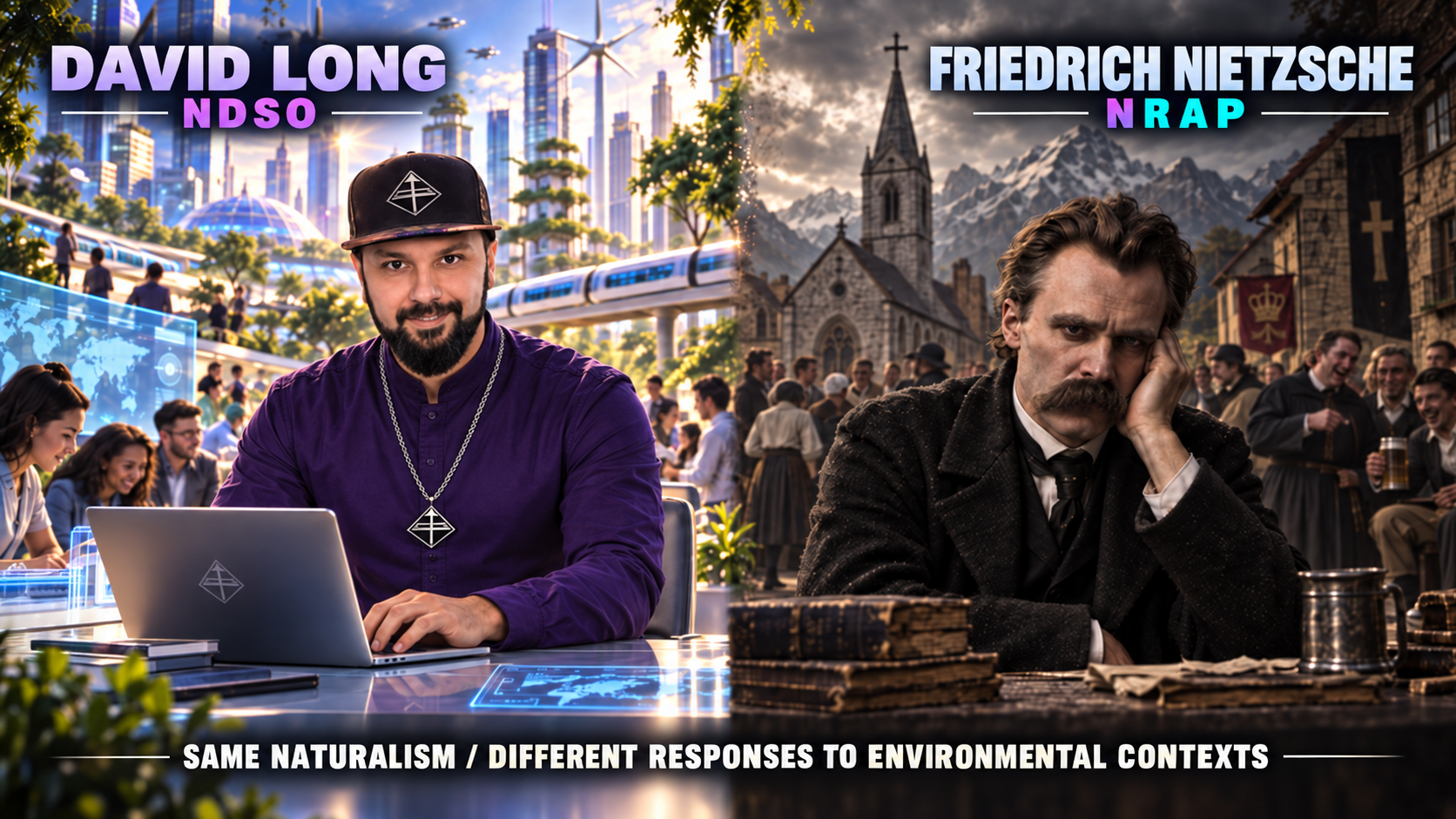
David Long VS Marx
Long / NRP: NDSO
Marx: NDSO
Here the important feature is not contrast but similarity. David Long’s Non-Reductionist Philosophy and Karl Marx’s philosophy share the same broad philosophical orientation even though they emerge in very different historical contexts and develop into very different kinds of projects.
Both are naturalist in rejecting supernatural explanations of society and human behavior. Both place substantial explanatory weight on material, social, historical, and systemic conditions rather than treating outcomes primarily as the product of isolated individual choice. Both are socially oriented in seeing human flourishing as something that depends heavily on the organization of collective life. And both are optimistic in believing that radically different social conditions can produce radically different forms of human existence.
Marx’s analysis is concentrated primarily on class, labor, ownership, production, economic structure, and the organization of industrial society. His revolutionary imagination is therefore centered largely on changing the economic relations that shape social life, especially the ownership and control of production.
Non-Reductionist Philosophy operates with a much broader developmental and meta-theoretical scope. Its concern is not only economic structure, but the larger architecture of civilization: education, governance, culture, development, technology, meaning, religion, economics, institutional design, and the conditions that shape human potential across multiple dimensions.
This difference is partly historical. Marx was working in the nineteenth century, before developmental psychology, systems theory, complexity science, modern cognitive science, digital communication, AI, and contemporary forms of institutional design existed. His analysis was necessarily built around the most powerful systemic forces visible in his time.
NRP emerges in a context where far more dimensions of human development can be studied, modeled, coordinated, and deliberately redesigned. Its revolutionary project can therefore aim at something broader than changing ownership or class structure alone. It can ask what education would look like if it were organized around development, what governance would look like if it were open-source and scientifically mediated, what religion would look like if mythology were preserved without literalism, and what economics might look like under post-scarcity conditions.
The comparison is useful because it shows that sharing a Philosophical Type means sharing a broad strategic architecture without requiring the same doctrine, application, domain, or scope. NDSO describes the deeper orientation and recurring strategic pattern underneath the philosophy, not the specific institutions, policies, theories, or historical projects through which that pattern is expressed.
Two thinkers can therefore share the same philosophical center of gravity while imagining very different futures because they are working with different historical conditions, different bodies of knowledge, and different ideas about what transformation has become possible.

Hobbes VS Marx:
Two Determinists, Opposite Social Expectations
Hobbes: NDAP
Marx: NDSO
Hobbes and Marx both place strong explanatory weight on causes and conditions rather than treating human behavior as simply the product of unconditioned choice. In both cases, people are understood as being shaped by forces larger than isolated individual intention.
Yet they draw very different conclusions from that causal picture.
Hobbes emphasizes fear, competition, insecurity, self-preservation, and conflict as persistent features of human social life. Because individuals are driven by these pressures, he sees political order as necessary to restrain destructive tendencies and prevent society from collapsing into instability. His determinism therefore combines with an Agentic and Pessimistic orientation: individuals are treated as relatively self-interested actors whose behavior must be constrained by strong institutions.
Marx also sees people as causally shaped, but he places much more emphasis on the social and material structures that produce behavior. Class position, ownership, labor relations, economic incentives, and institutional organization all help determine how people think and act. Where Hobbes tends to see conflict as emerging from relatively enduring features of human motivation, Marx is more likely to see conflict as emerging from historically specific social arrangements.
That difference matters because it changes what each thinker believes can be improved.
For Hobbes, the central problem is how to create enough order to manage dangerous or conflicting human tendencies. The solution is primarily one of constraint, authority, and stability.
For Marx, the central problem is how to transform the social conditions that generate alienation, exploitation, class conflict, and competition. The solution is therefore more collective, structural, and transformative.
At the strategy level, Hobbes’s Pessimism pushes Determinism toward Damage Control and Systemic Safeguarding, while Marx’s Optimism pushes it toward Progress Design and Systemic Transformation. Their shared causal orientation therefore generates sharply different practical responses.
This is also where their different expectations about human possibility become clear. Hobbes is comparatively pessimistic because he expects many of the pressures that produce conflict to remain persistent. Marx is more optimistic because he believes that changing the material and institutional structure of society can also change the kinds of relationships and behaviors that emerge within it.
The comparison is useful because it shows that determinism does not imply any single political or moral orientation. Two thinkers can agree that human behavior is causally shaped and still disagree radically about what those causes are, whether they can be transformed, what society should prioritize, and how much improvement is realistically possible.
In that sense, Hobbes and Marx share a causal worldview while diverging sharply on what that worldview means for society.

Hegel VS Wilber:
Same Idealism, Different Developmental Philosophy
Hegel: IDSO
Wilber: IRAP
Both Hegel and Wilber are developmental idealists, but they understand development in very different ways.
Hegel sees development as something that unfolds historically, socially, and institutionally. Individuals matter, but they are always embedded within larger cultural and historical processes. Freedom is not primarily an inward achievement. It is progressively realized through social institutions, ethical life, recognition, law, political organization, and the historical development of collective self-understanding.
That gives Hegel a strongly Determinist, Social, and Optimist orientation. Development is shaped by historical conditions and collective processes rather than primarily by isolated personal effort. The individual participates in a larger developmental movement, and human freedom becomes increasingly realized through the transformation of society itself.
Wilber shares the developmental emphasis but organizes it very differently. His work places much greater weight on the individual developmental journey: personal practice, stage growth, consciousness work, contemplative training, state development, and the possibility of higher realization.
This creates a much more Responsibility-oriented and Agentic developmental philosophy. The individual is expected to undertake the work of development through practice, reflection, discipline, and transformation. Culture and systems are still included, but the developmental center of gravity remains much more strongly located in the person.
The difference becomes even clearer in their expectations about how widespread higher development can become.
Hegel is fundamentally optimistic about development at the level of history. His philosophy interprets historical change as a process through which freedom and rational self-understanding become increasingly realized in collective life. Development is not limited to a small number of exceptional individuals. It is built into the historical movement of institutions, societies, and forms of consciousness.
Wilber is much more pessimistic in this sense. Higher stages and advanced realization are typically treated as difficult, uncommon, and achieved by relatively few people. Development may be available in principle, but its higher forms remain rare and depend heavily on individual effort, practice, and capacity.
So even though both thinkers are idealists and both place development at the center of their philosophy, they differ sharply in where development happens, what drives it, and how widely it can be expected to occur.
For Hegel, development is fundamentally historical and collective.
For Wilber, development is much more individual and aspirational.
This comparison also shows why the orientation layer matters. Hegel and Wilber share Idealism, but the other three positions completely change how that Idealism is expressed strategically. Hegel’s Determinist, Social, and Optimist combination directs Idealism toward historical unfolding, social order, systemic transformation, and collective development. Wilber’s Responsibility, Agentic, and Pessimist combination directs it toward personal practice, self-development, individual realization, and relatively rare higher attainment.
The same ontological position can therefore participate in very different strategic architectures depending on the other dimensions with which it is combined.
That is exactly the kind of difference Philosophical Types is meant to make visible.
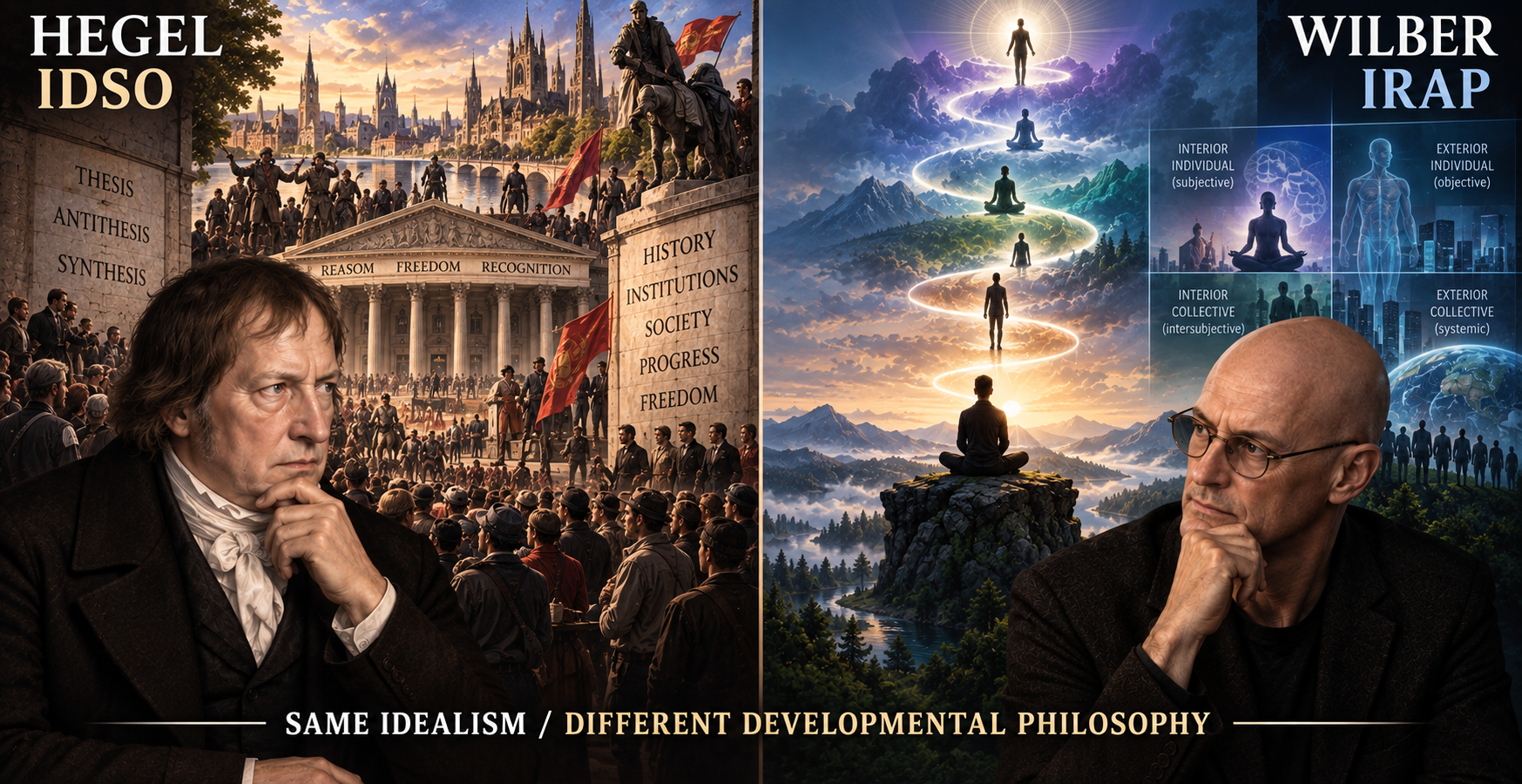
What Philosophical Types can reveal:
Philosophical Types is useful because it makes visible a layer of philosophical difference that is often hidden beneath more familiar categories.
It can help compare philosophers and traditions by showing how thinkers who address similar subjects may organize them around very different assumptions and priorities. It can also reveal similarities between thinkers whose specific theories, historical contexts, or political commitments otherwise look very different.
It can help identify deeper sources of disagreement. Two people may agree on many facts and values while repeatedly reaching different conclusions because one emphasizes responsibility while the other emphasizes causation, or because one prioritizes individual agency while the other prioritizes social wellbeing.
The strategy layer adds another level of precision. People may agree about a problem while disagreeing about the appropriate response because one favors Self-Reliance, another Condition Reform, another Systemic Safeguarding, and another Systemic Transformation. Philosophical Types can therefore reveal not only what people believe, but the recurring practical strategies those beliefs tend to generate.
It can also help explain differences within the same developmental stage. Developmental complexity does not automatically determine philosophical orientation. People may be capable of engaging the same level of complexity while still approaching reality, morality, responsibility, and possibility from different philosophical centers of gravity.
The framework can also reveal recurring worldview clusters. Although the dimensions are independent, certain combinations may reinforce one another and appear repeatedly across religious, philosophical, political, and cultural traditions.
At the individual level, Philosophical Types can support self-reflection. Recognizing one's own dominant orientations can make it easier to notice where certain explanations, values, or expectations are being foregrounded and where alternative perspectives may be getting less attention.
It may also improve philosophical dialogue. Instead of assuming that disagreement necessarily comes from ignorance, irrationality, personality, ideology, or developmental limitation, the framework provides another possibility: people may be emphasizing different legitimate dimensions of the same problem.
Finally, Philosophical Types helps distinguish philosophical orientation from personality, ideology, and developmental stage. These systems may interact, but they describe different things. A person's philosophical type concerns the recurring structure through which they tend to interpret reality and organize philosophical questions.
Philosophical Types is not meant to reduce people to four letters. It is meant to identify the philosophical center of gravity from which they tend to interpret the world.