

Levels of Affiliation, Leadership & Integration
Non-Reductionism is not only a philosophy. It is also the foundation for building a real community, culture, and movement.
For a movement to remain healthy as it grows, it needs more than good ideas. It needs clear standards, clear roles, healthy onboarding, meaningful pathways to leadership, and processes for refinement, accountability, and integration.
Many philosophical, spiritual, political, or online communities fail because they lack these structures. Some revolve around one central leader, which can create dependence, personality worship, and a lack of accountability. Others are completely flat, which often leads to confusion, ego battles, informal power structures, and people asserting authority without training, competency, or accountability.
Non-Reductionism is being built differently.
The goal is to create a structured pathway where people can move from curiosity, to participation, to membership, to leadership, to mastery, and eventually to council-level responsibility. Each level reflects a deeper degree of understanding, integration, responsibility, and capacity to serve the larger project.
The levels of affiliation can be understood through the metaphor of a city.
Outside the city are people who are unaware of Non-Reductionism. They have not encountered the philosophy, the community, or the movement.
Closer to the city are observers. These are people who are watching from the outside. Some are good-faith observers who partially resonate with the project but still have questions, criticisms, or hesitations. Others may be harsher or bad-faith observers who are unlikely to participate constructively.
At the city gates are the interested. These are people who want to learn more, explore the ideas, and potentially move into the community.
Inside the city are community members. These are people who identify with Non-Reductionism, support the project, study the basics, participate in the community, and begin applying the philosophy in their own lives.
Moving deeper inward, the first formal level of leadership is stewardship. Stewards help guide new members, answer questions, preserve the integrity of the foundational material, and support healthy community integration.
Beyond stewards are scholars. Scholars are master practitioners of Non-Reductionist Philosophy. They understand the deeper frameworks and can apply them across domains such as business, governance, religion, life practice, education, organizational systems, and culture.
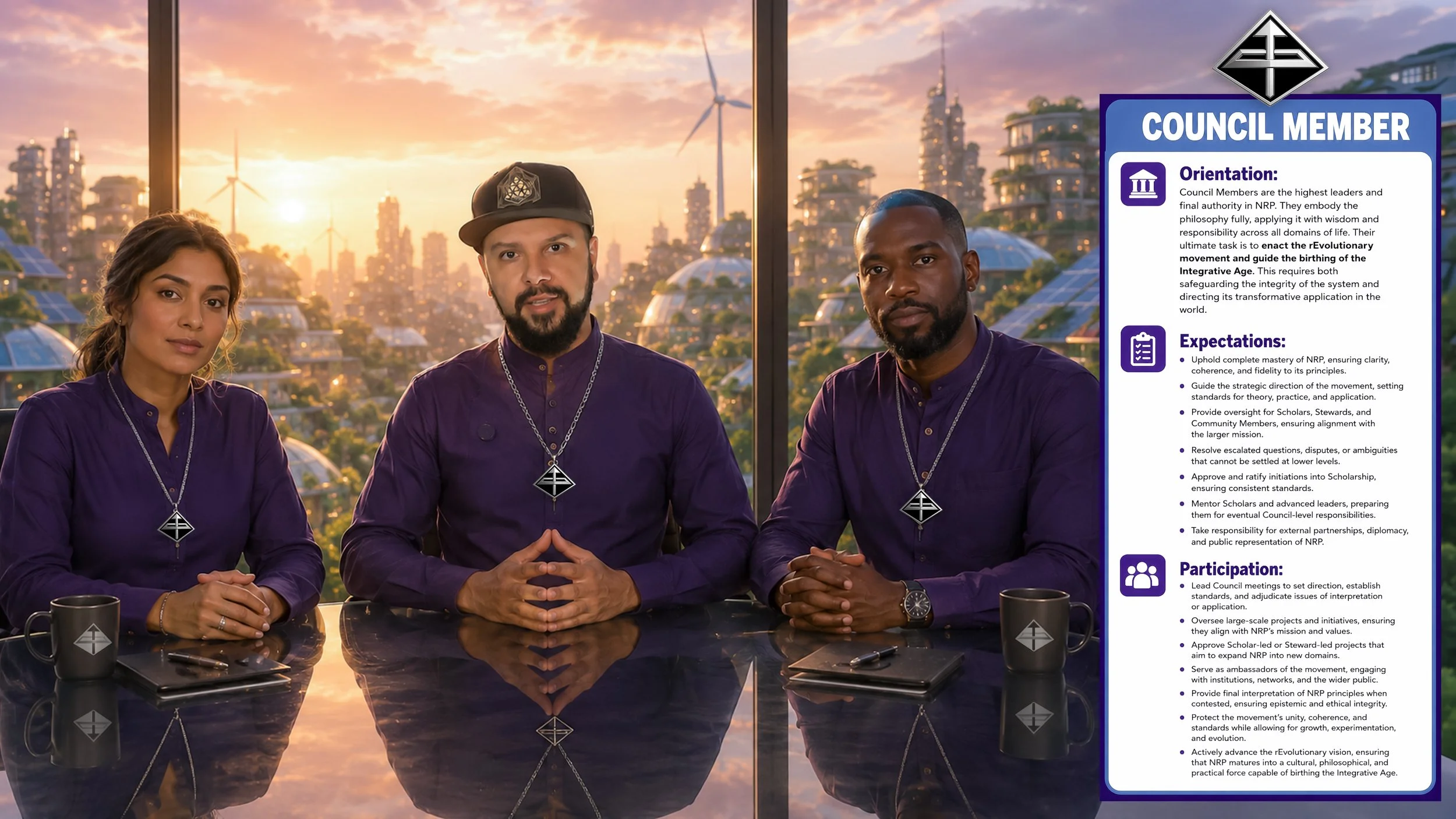
At the center are council members. Council members hold the highest level of responsibility. They help preserve the integrity of the philosophy, guide the long-term development of the movement, resolve higher-level questions, and coordinate large-scale strategic direction.

NRP AS A CITY: Circles Within Circles
The Levels of Affiliation
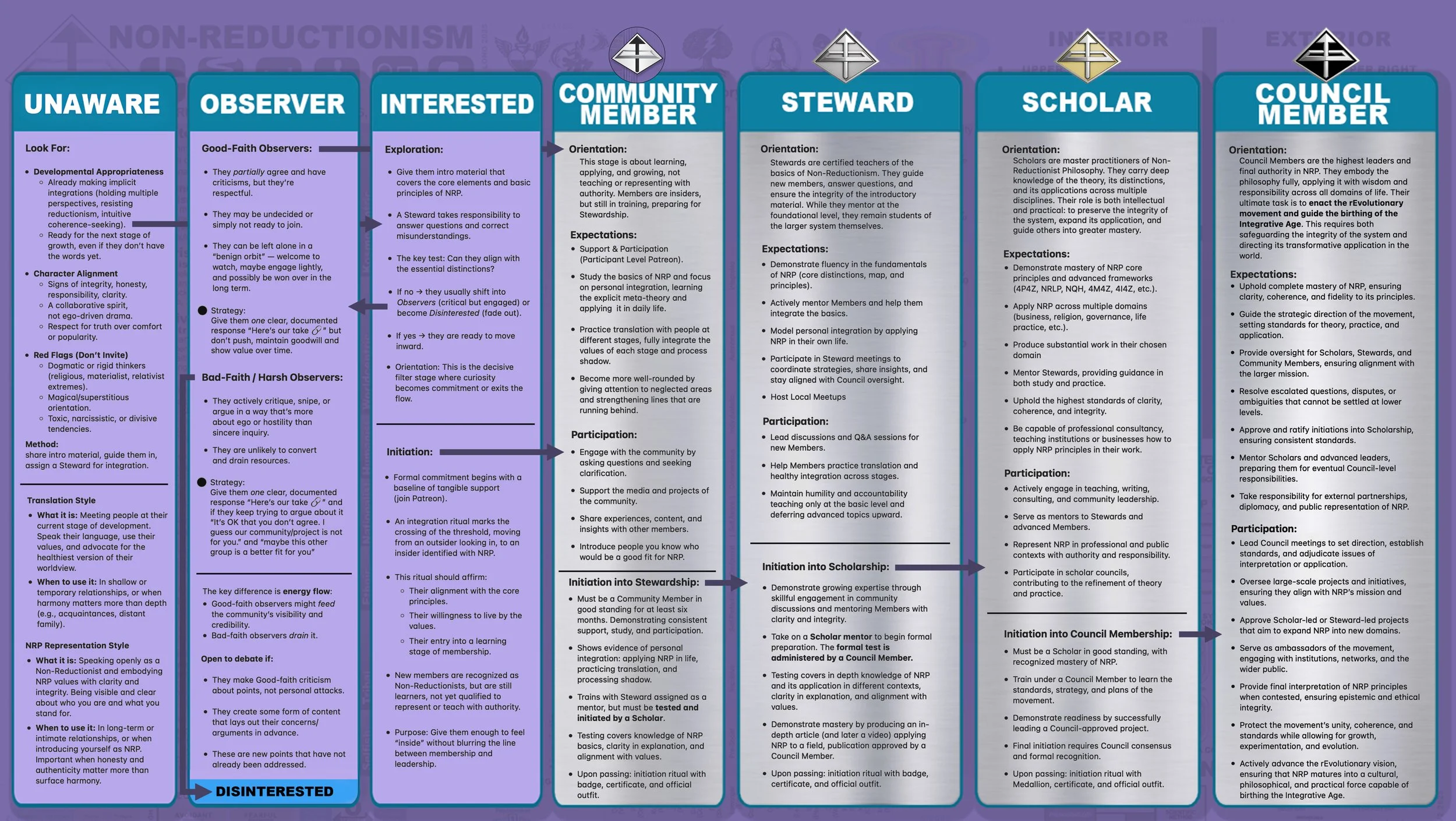
1. Unaware
The unaware are people who have not yet encountered Non-Reductionism or do not yet understand what the project is.
When engaging people at this level, the goal is not to force the philosophy on everyone. The goal is to recognize who may be developmentally ready for these kinds of distinctions.
We are looking for people who already show signs of developmental appropriateness, such as holding multiple perspectives, resisting reductionism, valuing truth over comfort, and making implicit integrative distinctions.
We are also looking for character alignment: honesty, responsibility, clarity, collaboration, humility, and respect for truth.
Red flags include rigid dogmatism, magical thinking, shallow relativism, narcissism, power hunger, divisiveness, and toxic social behavior.
Not everyone is a fit for this project, and that is healthy. A serious movement needs both invitations and boundaries.

2. Observers
Observers are people who remain outside the formal community but are aware of the project.
Some observers are good-faith. They may agree with parts of Non-Reductionism but still have criticisms or unresolved questions. These people can sometimes contribute useful feedback and may eventually move closer if their concerns are addressed.
Others are bad-faith or harsh observers. These people may primarily engage through hostility, ego, sniping, or repeated criticism that does not reflect sincere inquiry.
The proper response to observers is clarity without endless argument. Good-faith criticism should be answered clearly, ideally through documented responses, videos, articles, or living FAQ-style resources. Bad-faith criticism should not be allowed to drain the movement’s energy indefinitely.
The key difference is energy flow. Good-faith observers may contribute to clarity and refinement. Bad-faith observers drain attention and weaken focus.

3. Interested
The interested are people who actively want to learn more.
At this stage, the focus is exploration. Interested people should be given introductory material that covers the core principles, basic elements, and foundational distinctions of Non-Reductionism.
A steward or developing leader may help answer their questions and correct misunderstandings.
The key test at this stage is whether the person can align with the essential distinctions. If they cannot, they may remain observers or eventually disengage. If they can, they may be ready to move inward and become community members.
This is where the first meaningful threshold appears. The person is no longer merely watching from the outside. They are beginning to identify with the project.

4. Community Members
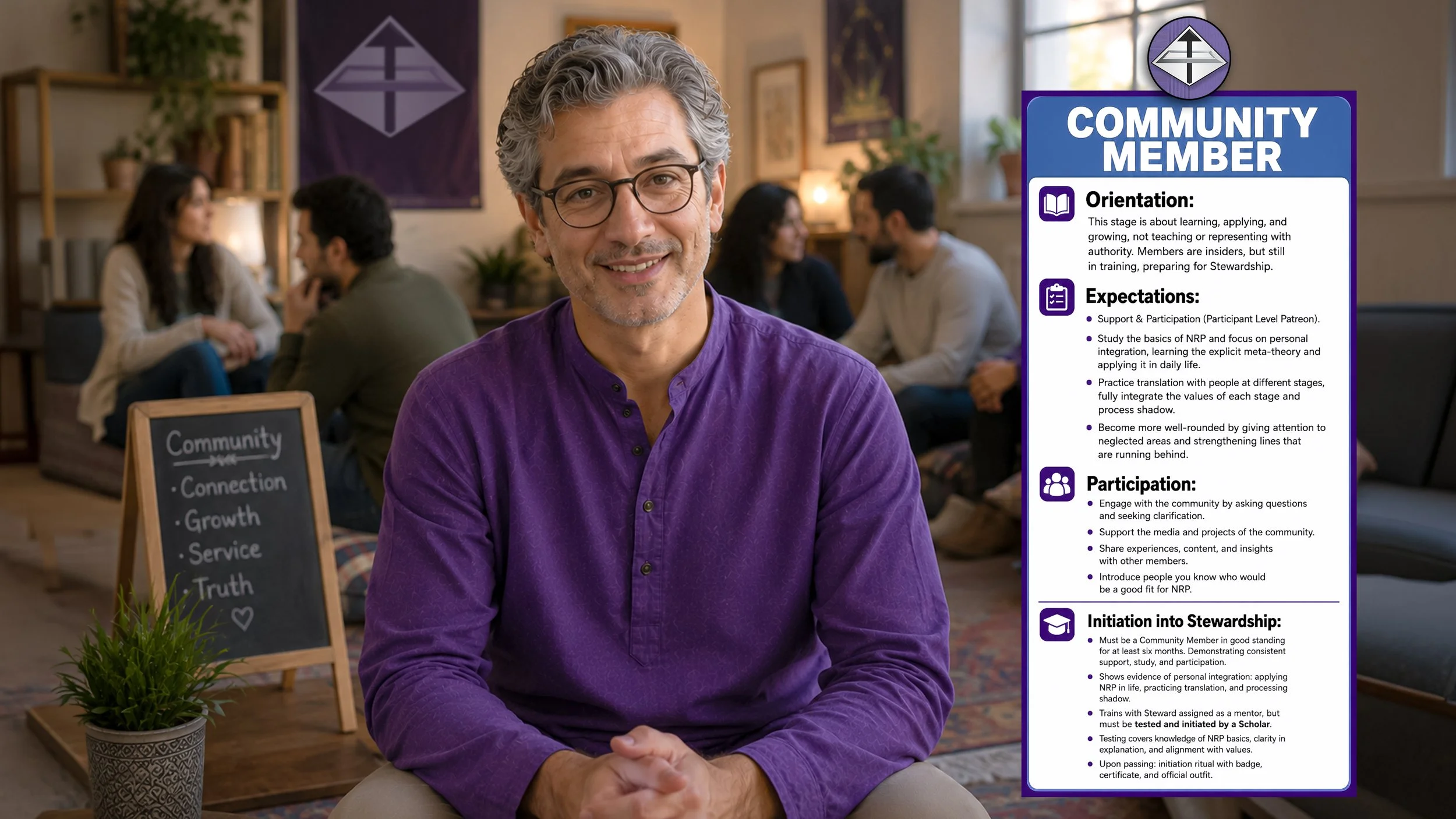
Community members are insiders, but they are still learners.
This stage is about learning, applying, and growing. It is not yet about teaching or representing Non-Reductionism with authority.
Community members are expected to study the basics of the philosophy, participate in the community, support the project, and work on personal integration.
This includes learning the explicit meta-theory, applying it in daily life, practicing translation with people at different stages, processing shadow, strengthening neglected lines, and becoming more well-rounded.
Community members can also help by sharing content, asking questions, supporting media projects, introducing aligned people to the community, and participating in discussions.
The focus here is integration before leadership.
5. Steward Leaders
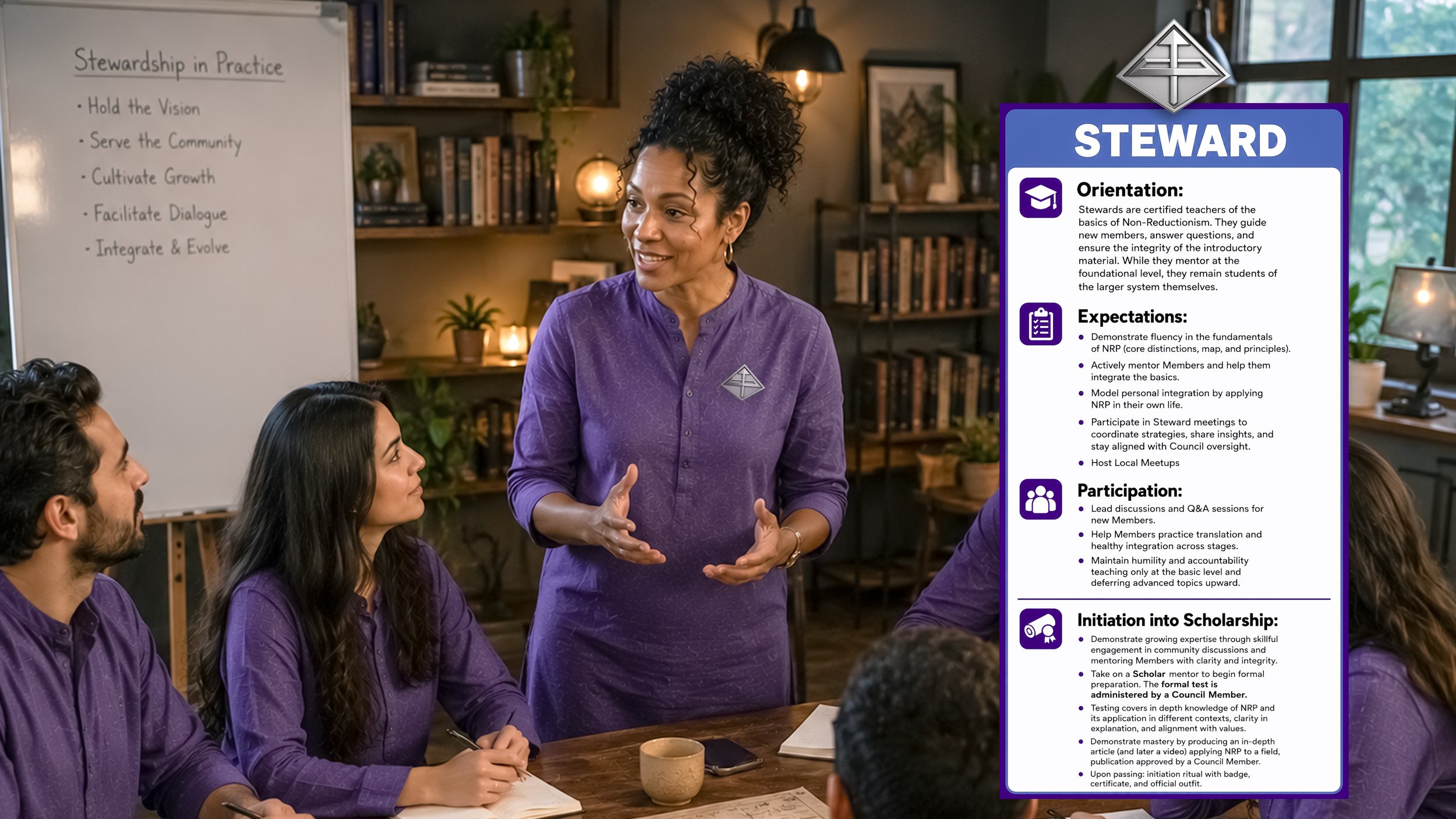
Stewardship is the first formal level of leadership within Non-Reductionism.
Stewards are certified teachers of the basics. They are not expected to know everything, but they are expected to demonstrate fluency in the fundamentals.
Their role is to guide new members, answer foundational questions, support integration, and preserve the integrity of the introductory material.
Stewards help build the bridge between the philosophy and the community. They are the people who can help newcomers understand where they are, what they need to study, how to participate, and how to move forward.
Stewards may eventually help lead discussions, Q&A sessions, local meetups, and community integration spaces.
This is one of the most important levels because stewardship is where the movement begins to become real in the world.
6. Scholars
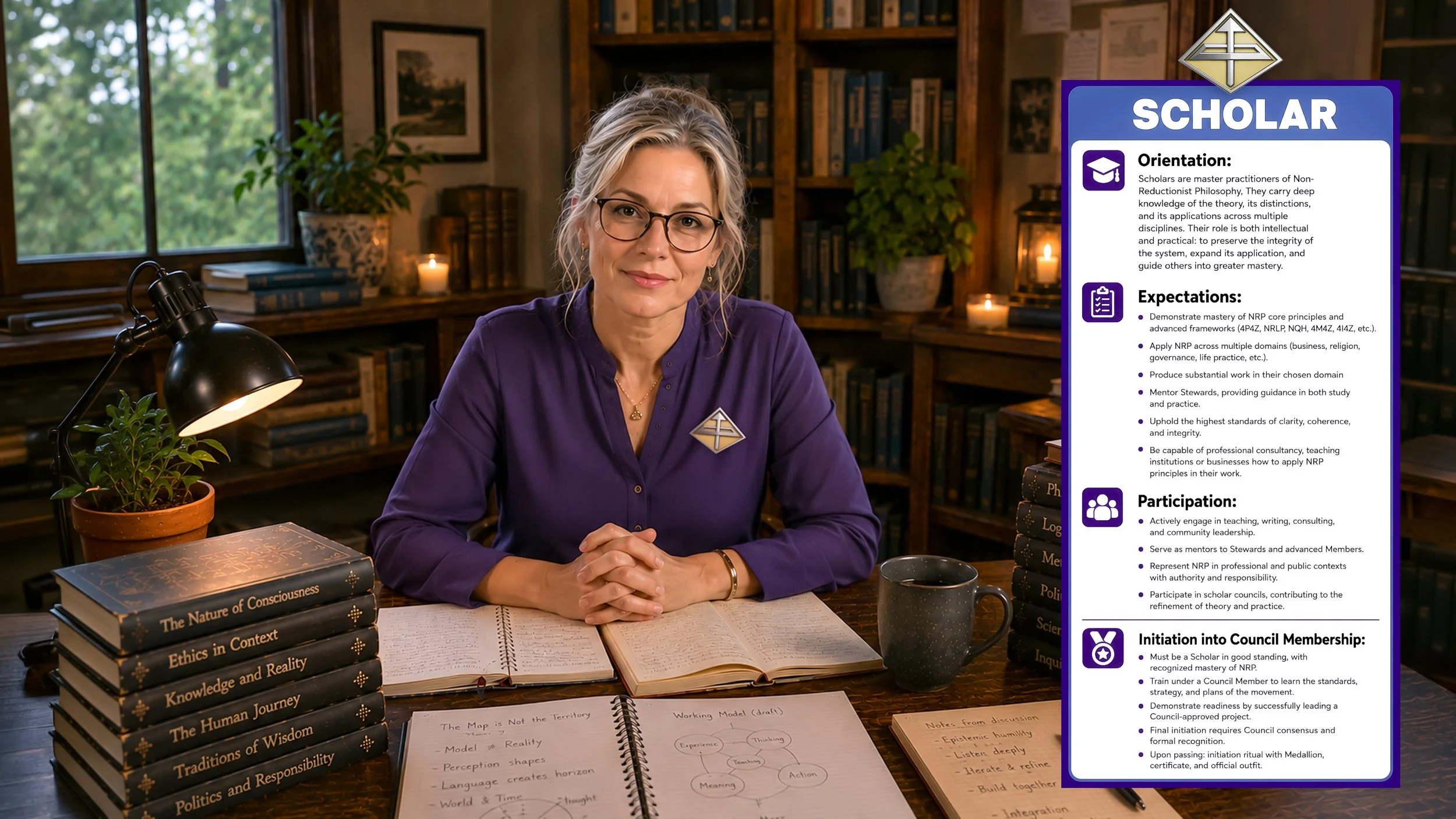
Scholars are master practitioners of Non-Reductionist Philosophy.
They understand not only the basics, but also the deeper frameworks and applications. They can apply Non-Reductionism across multiple domains, including business, governance, religion, spirituality, life practice, education, organizational systems, and culture.
Scholars are expected to produce substantial work in their chosen domain and contribute to the refinement and application of the philosophy.
They may mentor stewards, represent Non-Reductionism in public and professional contexts, consult with institutions or businesses, and help expand the practical application of the system.
The move from steward to scholar is one of the most significant jumps because it requires not just knowledge, but practical mastery across contexts.
7. Council Members
Council members are the highest level of responsibility within the movement.
They are not simply experts in the philosophy. They help guide the long-term direction of the movement itself.
Council members preserve the integrity of the system, resolve major interpretive questions, oversee large-scale projects, approve higher-level initiations, mentor advanced leaders, and help guide the broader revolutionary vision of Non-Reductionism.
The council level is not about personal power. It is about responsibility, stewardship, and strategic direction.
The long-term goal is not for Non-Reductionism to depend on one person. The goal is to build a living system with multiple stewards, scholars, council members, and healthy processes of refinement and continuity.
Why Structure Matters
Most communities and movements eventually run into the same structural problems.
Some become overly centralized around a single charismatic figure. In these environments, authority is often informal, loyalty-based, and highly dependent on proximity to the founder or core social circle. Leadership succession becomes unclear, criticism becomes difficult to process in healthy ways, and the movement can easily drift into personality-centered dynamics rather than principle-centered development.
If the central figure disappears, burns out, loses credibility, or simply stops participating, the entire ecosystem can destabilize because too much of the structure depended on one person functioning as the center of gravity.
At the same time, the opposite extreme creates its own problems.
Completely flat communities often struggle to maintain coherence because there are no legitimate pathways into leadership, no standards for representation, no onboarding process, no mentorship structure, and no clear mechanisms for accountability, refinement, or decision-making. Over time, informal power structures still emerge, but they tend to be driven more by social dynamics, confidence, popularity, or persistence than by demonstrated competency or responsibility.
In these environments, people frequently begin asserting authority for themselves without having gone through any meaningful process of study, testing, integration, or accountability. This often leads to fragmentation, factionalism, misinformation, interpersonal conflict, and endless disputes about who should be trusted or listened to.
Healthy communities require more than shared interest. They require legitimate structures for participation, growth, refinement, contribution, leadership development, and accountability.
People need meaningful ways to enter the community, learn the foundational material, build relationships, develop competency, contribute to the project, and gradually take on greater levels of responsibility over time.
There also need to be healthy mechanisms for criticism, refinement, disagreement, and evolution within the system itself. Without these processes, tension tends to spill into unhealthy social dynamics instead of being productively integrated into the movement’s ongoing development.
Likewise, healthy communities require boundaries. Not every person, worldview, or behavioral pattern is compatible with every project. Sustainable cultures require standards, shared values, and the ability to maintain integrity over time without collapsing into either authoritarian rigidity or total relativistic fragmentation.
Non-Reductionism is being developed with these realities in mind.
The goal is not simply to create an audience, a fan community, or an online discussion space. The goal is to cultivate a durable philosophical and cultural framework capable of supporting leadership development, long-term refinement, coordinated action, real-world application, and healthy community integration across scales.
This requires intentional structure.
It requires onboarding pathways, mentorship systems, standards for leadership, legitimate methods of evaluation, healthy channels for criticism and refinement, and meaningful opportunities for participation and contribution.
Rather than organizing the movement around unquestionable personal authority, the broader aim is to develop a system capable of continuously refining and improving through the participation of increasingly capable, integrated, and responsible people over time.
Leadership, Authority, and Responsibility
Within Non-Reductionism, leadership is not treated as a matter of status, dominance, popularity, or personal importance.
Leadership is understood primarily as responsibility.
Different levels of affiliation and leadership reflect different degrees of demonstrated understanding, integration, competency, accountability, and ability to responsibly represent and apply the framework.
This creates a knowledge-based and responsibility-based hierarchy rather than a hierarchy of human worth or social superiority.
Advancement is not intended to function as a time-based reward system. Progression into leadership roles is tied to demonstrated understanding, participation, alignment with the principles of the framework, practical integration, and the ability to contribute constructively to the larger movement.
The intention is to create structures where authority emerges from competency, responsibility, accountability, and contribution rather than from social proximity, personal loyalty, charisma, or self-assertion.
One reason institutional systems such as academia function relatively well in certain respects is because positions of authority are connected to recognizable standards, training processes, testing, peer evaluation, and broader systems of accountability. While no institution is perfect, these structures help create legitimacy and establish clearer grounds for why certain individuals are trusted to teach, evaluate, or represent a field.
Non-Reductionism seeks to apply a similar principle to philosophical and cultural leadership development while grounding it in community integration, mentorship, and practical application.
Mentorship, Testing, and Refinement
One of the structural principles within the movement is that individuals are generally mentored by the level above them while being evaluated by the level beyond that.
For example, a developing steward may be trained and supported by an existing steward while ultimately being evaluated by a scholar or council-level authority.
This structure is intended to preserve both support and accountability simultaneously.
Mentors can focus on helping individuals grow, integrate the material, ask questions, and prepare for leadership responsibilities without the relationship becoming distorted by sole evaluative authority. At the same time, evaluation by a higher level helps reduce favoritism, social pressure, and informal loyalty dynamics.
The movement is also intended to remain open to ongoing refinement.
Non-Reductionism is not presented as a finished or infallible system. The maps, structures, terminology, applications, and organizational methods are all expected to continue evolving through critique, experimentation, dialogue, practical implementation, and collective refinement over time.
The objective is not ideological rigidity, but increasingly coherent integration grounded in clear standards and healthy evaluative processes.
Specialized Training and Future Development
As the movement develops, additional forms of training, specialization, and certification will likely emerge.
Different people naturally develop different strengths and areas of competency. Some may focus more heavily on mentorship, communication, education, governance, organizational systems, philosophical analysis, consulting, developmental understanding, or community leadership.
Over time, more specialized tracks may help cultivate focused mastery and allow people to contribute to the movement in increasingly skillful and differentiated ways.
The intention is not merely to create ranks or titles, but to foster genuine capability, responsibility, practical competency, and meaningful contribution across many different domains of life and application.
Symbols, Rituals, and Cultural Identity
As Non-Reductionism develops into a more established culture and movement, symbolic structures will likely become increasingly important.
This may include badges, milestones, initiation rituals, certifications, visual symbols, official roles, and other forms of recognition associated with different stages of participation and leadership.
These are not viewed merely as cosmetic additions or arbitrary status markers.
Human beings naturally organize identity, meaning, belonging, responsibility, and developmental transition through symbolic structures. Universities, martial arts traditions, professions, religions, militaries, and cultural groups all utilize rituals and symbols to reinforce identity, responsibility, progression, and social cohesion.
If Non-Reductionism is to function as a durable cultural and philosophical movement rather than merely an online discussion space, these dimensions become increasingly relevant.
Steward Leadership Training
Stewardship represents the first formal level of leadership within Non-Reductionism.
Steward Leaders help preserve the integrity of the foundational material, support new members, answer questions, guide integration, and help facilitate healthy community development both online and eventually in local real-world spaces.
For individuals who strongly resonate with the philosophy and want to become more deeply involved in the movement, Steward Leadership training provides the primary pathway into formal leadership development.
The training process is designed not only to transmit information, but also to cultivate integration, mentorship, accountability, communication skills, and collaborative leadership capacity.
While the foundational educational material is publicly available through videos, writings, and online resources, the structured training process offers direct mentorship, real-time clarification, group discussion, shared development, and guided preparation for evaluation.
In the future, there may also be opportunities for individuals to test directly into certain levels if they have already independently studied the material extensively. However, even in these cases, mentorship and evaluation structures will still play an important role in maintaining healthy standards, accountability, and integration.
Individuals who align strongly with the principles and goals of Non-Reductionism and who want to participate more actively in helping develop the movement are encouraged to apply for Steward Leadership training.
The long-term goal is the development of a movement capable of sustaining healthy leadership, meaningful integration, philosophical refinement, and coordinated cultural contribution over time.